

ADU Builder in Long Beach, CA: Its Own Counter, None of the LADBS Queue
A city with its own permit counter, its own pre-approved plan catalog, and none of the LADBS queue.
What should you know before building an ADU in Long Beach?
| Who reviews your plans | Long Beach Community Development, an independent counter, NOT LADBS |
| The head start | The city runs a Pre-Approved ADU Program (PAADU): city-vetted designs that cut design and plan-check time |
| State-law floor | 4-ft side/rear setbacks and ministerial approval apply, same as everywhere in California |
| Best fit | Garage conversions and detached units on the city’s older, generous lots |
| No local ordinance | Long Beach administers state ADU law directly. LBMC 21.51.276 no longer applies while a replacement is drafted |
| Volume | Per the city’s own Community Development page, the highest per-capita producer of ADUs in California |
| Pre-approved plans | New construction only, conversions of existing space do not qualify for the catalog |
Homeowners hear “Los Angeles County” and brace for the LADBS experience. Long Beach is the good news: it is an independent city with its own Community Development department, its own counter, and (unusually) its own catalog of pre-approved ADU designs. The city publishes the PAADU program precisely to save owners design time and plan-check rounds, which tells you something about its posture: Long Beach wants these units built.
How many ADUs actually get built in Long Beach?
Long Beach issued building permits for 644 ADUs in 2025, and 3,493 in total since 2018. These are the city’s own figures, filed with the State of California, not an estimate.
| Year | ADU building permits issued in Long Beach |
|---|---|
| 2018 | 59 |
| 2019 | 151 |
| 2020 | 268 |
| 2021 | 444 |
| 2022 | 509 |
| 2023 | 671 |
| 2024 | 747 |
| 2025 | 644 |
For scale: ADUs were 39.5% of every home permitted in Los Angeles County in 2025 (nearly two in every five), and 25.9% of every home permitted statewide. Full city-by-city tables are on our California ADU statistics page.
Source: California Department of Housing and Community Development, Housing Element Annual Progress Report, Table A2, units with building permits issued. Retrieved August 2026.
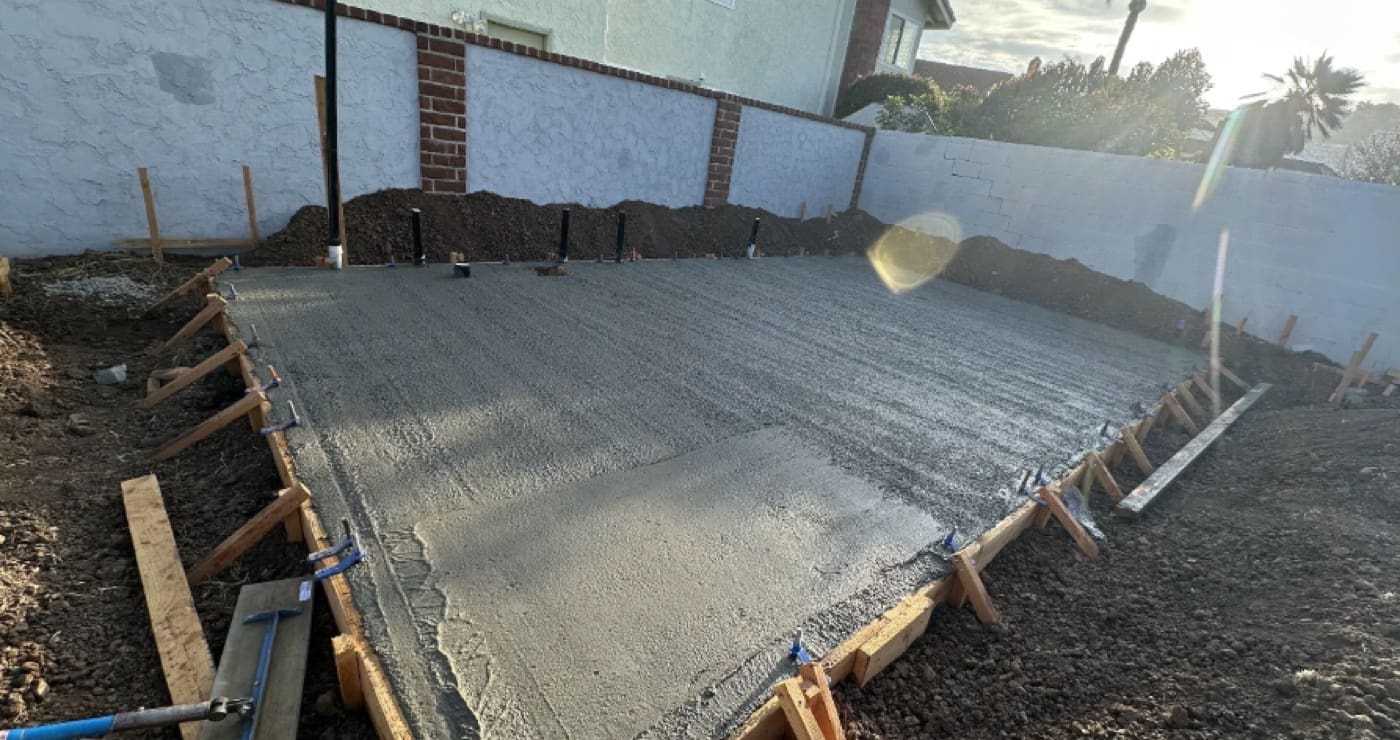
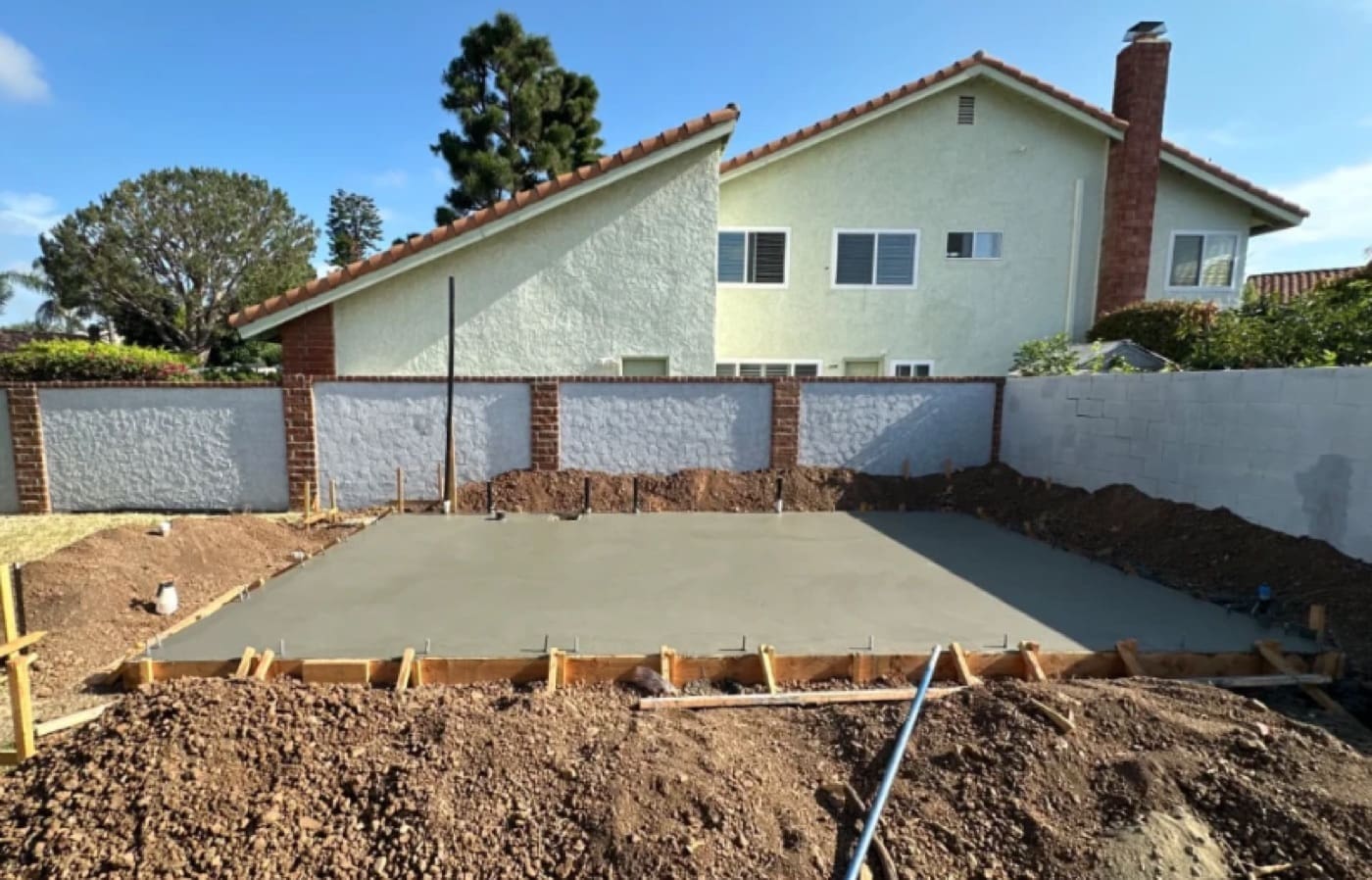
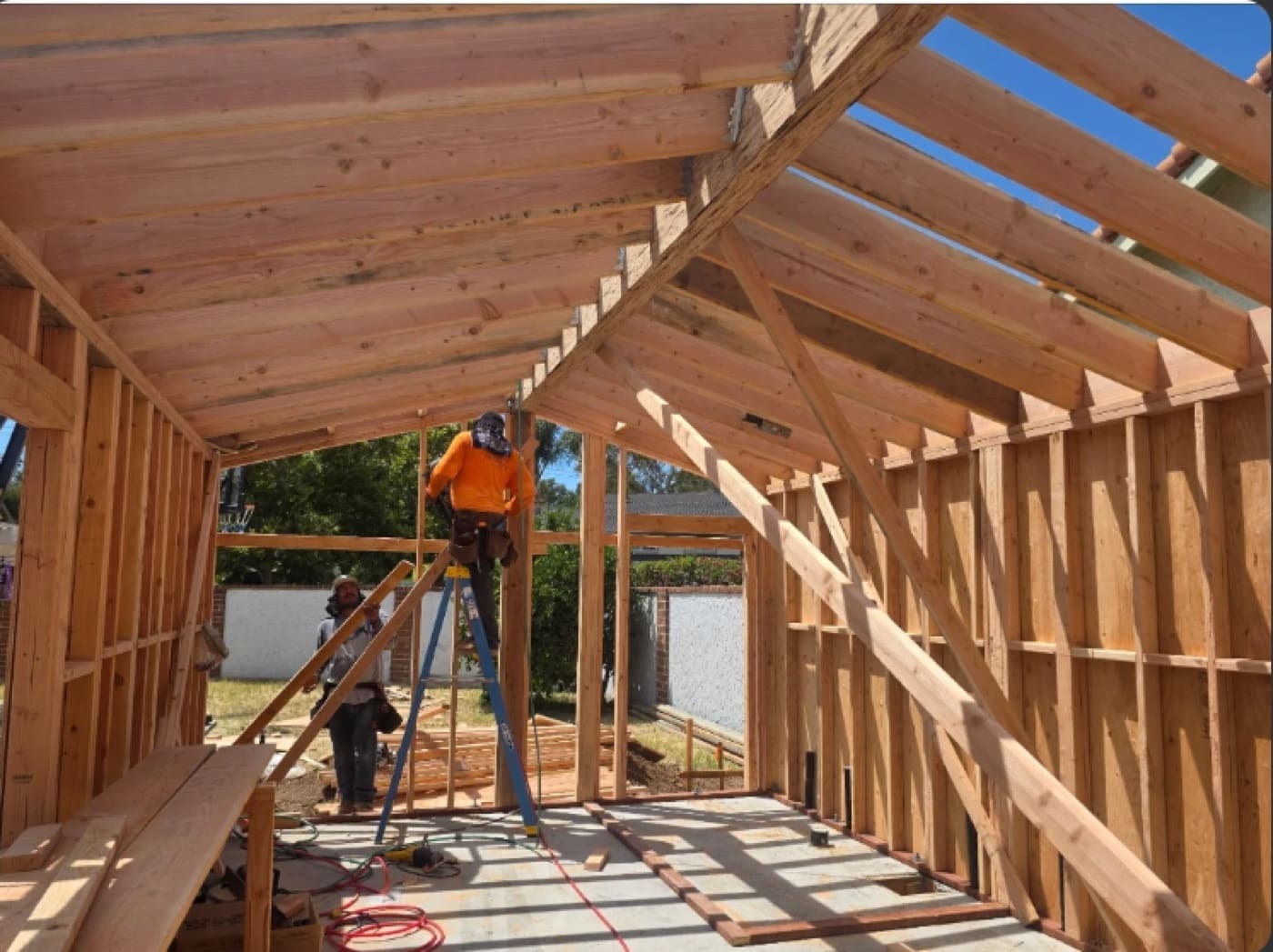
What does an ADU look like at each stage of the build?
The photographs below are our own, taken on L Square job sites. Every caption states where and when the picture was taken. None of them are stock images or renderings, and none of them are presented as work in Long Beach unless the caption says so. The sequence is the same on every project: forms and rebar, the pour, the cured slab, then framing.

What does an ADU builder in Long Beach actually do?
Choosing an ADU builder in Long Beach means coordinating ADU design in Long Beach, the city’s permit process and construction as one connected scope. Long Beach homeowners can compare the city’s PAADU catalog, where fixed pre-approved designs can reduce design and plan-check work, with a custom design when the catalog does not fit the lot or the project needs.
The permit path still runs through Long Beach Community Development, not LADBS. Use the permit requirements guide as a general planning checklist, then confirm Long Beach-specific requirements through the city’s current review process. Compare the ADU cost guide before choosing between a PAADU design, a custom detached unit or a garage conversion ADU and carrying the approved scope into construction.
What is different about building an ADU in Long Beach?
The permit path, first. Your application goes to Long Beach’s own Community Development department, not the LADBS queue that city-of-LA projects stand in. Independent counters generally mean shorter lines and reviewers who know their own code, and Long Beach’s published ADU regulations are laid out clearly enough that a complete submittal moves without drama.
Then the PAADU catalog. Long Beach maintains a set of pre-approved ADU designs, pick one and the structural review is largely already done, which compresses both design cost and plan-check time. The trade-off is the same as every pre-approved program: the plans are fixed. If your lot or your needs do not fit the catalog, a custom design through the normal process is still fully available. We price both routes against each other so the catalog is a choice, not a constraint.
The housing stock plays along. Much of Long Beach was built in eras of real backyards and detached garages, which means the two classic ADU plays (the garage conversion and the backyard detached unit) both fit a large share of lots. Coastal-adjacent parcels can carry extra review, which is a lookup we run before design, not after.
Long Beach is the unusual case in this region: right now it has no ADU ordinance of its own. The city administers state ADU law directly, and its Community Development page states that Long Beach Municipal Code 21.51.276 no longer applies while a replacement ordinance is drafted. For a homeowner that cuts both ways. There is no local overlay of extra standards to satisfy, which genuinely simplifies things, but it also means the answer to nearly every question is whatever state law says today, and state ADU law has changed almost every year since 2020. Long Beach is also, by the city’s own account, the highest per-capita producer of ADUs in California: the reviewers here have seen more of these than almost anyone in Southern California.
Two practical details save time on a Long Beach submittal. First, the city’s pre-approved ADU program covers new construction only. If you are converting a garage or interior space the catalog does not apply and you are on the custom path from the start. That is worth knowing before you fall for a plan you cannot use; compare the trade-off against our own standard floor plans and the garage conversion route. Second, plans go in at the Permit Center as a complete digital PDF set on a USB drive together with the development permit application, and once plan-check fees are paid a Planner and an Engineer review concurrently rather than in sequence. That concurrency is exactly why a complete first submittal matters more here than a fast one, our construction checklist sets out what a complete package contains.
The city publishes two documents worth reading before you draw anything: a Planning Information Bulletin on ADUs, which summarises the state law the city is applying, and a separate set of Building & Safety ADU FAQs covering the construction side. Because Long Beach is running state law directly rather than a local ordinance, those bulletins are guidance rather than additional rules, useful, but not the authority. When the two ever appear to diverge, the statute wins, which is why we read the bulletin against the code rather than instead of it.
One thing Long Beach’s volume changes is the quality of the comparables. When a city is the state’s highest per-capita producer of ADUs, an appraiser pricing your finished unit has actual local sales to point at rather than an argument to construct, and a lender underwriting the project has the same. That matters more to the economics than most homeowners expect. It is the difference between a second unit that reads as an asset on paper and one that reads as an improvement. The ROI calculator is the honest way to test that against your own numbers.
One geography-specific point for Long Beach: parts of the city sit inside the coastal zone, and where a certified Local Coastal Program conflicts with state ADU law, the LCP governs. The protection that survives is the clock. An application still has to be approved or denied within 60 days. In practice that means a project in Belmont Shore or on the Peninsula can carry a review layer that an identical project two miles inland does not, and the time to find that out is when we check the parcel, not when the drawings are finished.
The neighbouring contrast is unusually sharp. Lakewood next door applies its objective standards closely and has publicly opposed state housing legislation, while Long Beach has no local ADU ordinance at all and administers state law directly. Torrance across the bay keeps its rules in a municipal code section with a published process handout. Long Beach is the most permissive of the three on paper.
What does California law guarantee an ADU owner in Long Beach?
A city ordinance sits on top of state law, never underneath it. Four sections of the Government Code decide what Long Beach can and cannot require of your project. Each one links to the full text on the Legislature’s own site, so you can read the wording rather than take our summary for it.
| GOV §66316 | A local ADU ordinance may contain only ministerial provisions. That is why a code-compliant ADU in Long Beach gets no public hearing, no discretionary review and no neighbor veto. |
| GOV §66314 | Sets out what a local ordinance has to do, including designating where ADUs are allowed. It also carries the parking exemptions, so no replacement parking can be demanded when a garage becomes the unit. |
| GOV §66321 | A city may set minimum and maximum unit sizes, but it cannot impose a minimum square footage that blocks an ADU, and its maximum cannot be set below the state floor of 850 sq ft, or 1,000 sq ft for more than one bedroom. |
| GOV §66333 | Governs junior ADUs: up to 500 sq ft, created inside an existing single-family home, with a permit and a recorded deed restriction, and rented for terms longer than 30 days. |
If something a city asks for conflicts with these sections, the state text governs. That is worth knowing before you agree to redraw a plan set.
What does an ADU cost in Long Beach?
Our published ranges cover Long Beach the same as the rest of our service area: garage conversions typically $90,000–$150,000, detached units $200,000–$450,000+. The PAADU route can trim the design line-item; the build cost stays the build cost. Full breakdown in the cost guide and the LA hub.
What actually decides the price on your lot?
Two identical floor plans on two Long Beach streets can price differently, and the reason is almost never the city. It is these seven site conditions, which is why we quote after standing on the property rather than from an address.
| Electrical panel | Whether the existing service can carry a second dwelling, or the job needs a subpanel and a service upgrade. |
| Sewer route and distance | The trench length from the unit to the existing lateral, and whether the fall works or a pump is required. |
| Gas | Whether gas gets extended to the unit or the design goes all-electric, which changes both the trenching and the equipment. |
| New meters | Whether the utility wants separate meters, and the lead time that adds to the schedule. |
| Demolition | What has to come out before anything goes in, and whether something undocumented is sitting behind it. |
| Slope | Stepped foundations, retaining and engineered drainage. This is the most expensive category of site surprise in Southern California. |
| Access | Whether a truck and equipment can reach the back of the lot, or every yard of concrete and every sheet of drywall is carried by hand. |
Published model prices and the full range by size are on the Orange County ADU cost guide. The seven items above are what turn that range into a number for your property.
What will your Long Beach lot allow?
Send the address and we will come back with what the lot allows and a free estimate.
What do Long Beach homeowners ask most often?
Does Long Beach use LADBS for ADU permits?
What is the Long Beach Pre-Approved ADU Program?
Is a pre-approved plan always the cheaper route?
What does an ADU cost in Long Beach?
Does Long Beach have its own ADU ordinance?
Can I use the pre-approved plans for a garage conversion?
What do I actually bring to the Permit Center?
Is Long Beach harder to build in than nearby cities?
How many ADUs are permitted in Long Beach each year?
Where can Long Beach homeowners check the rules themselves?
Ready to start
your ADU?
Get a free, no-pressure quote from a licensed Orange County design-build team, and a plan drawn around your lot.