

For an Orange County ADU permit in 2026, identify the reviewing city or county first, then submit a complete plan set built around the actual parcel.
Last updated: August 2026
L Square Design & Build (CSLB #1095476) designs, permits and builds ADUs and junior ADUs across Orange County and Los Angeles County. For a free estimate on your property, call (949) 374-7980, or start with what an ADU costs in Orange County and ADU rules by city.
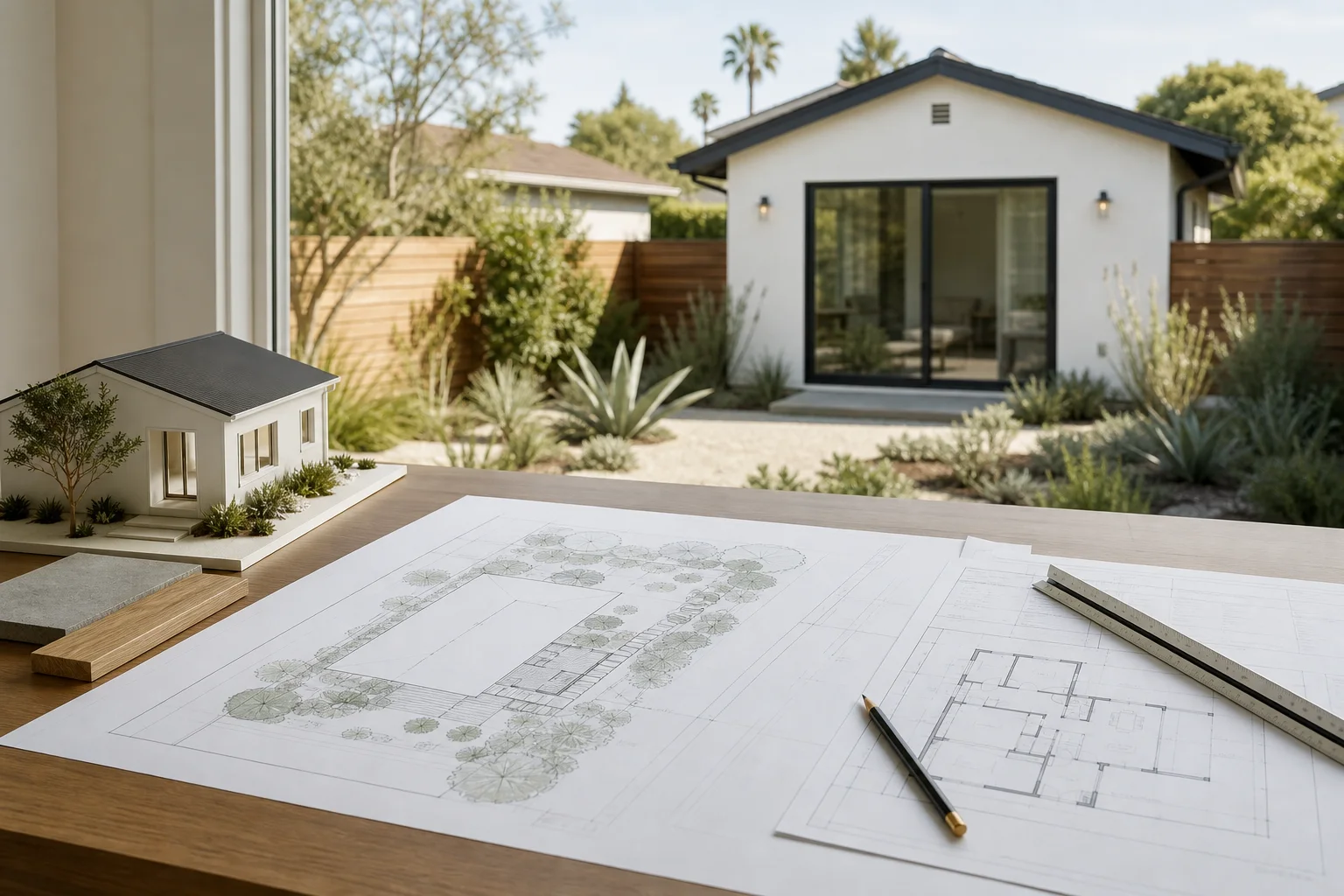
The reviewing agency must provide a written completeness determination within 15 business days. For a completed ADU application on a lot with an existing dwelling, the agency generally must approve or deny the application within 60 days. An applicant-requested delay tolls that period, and incomplete submissions or correction cycles can extend the actual calendar. These are review rules, not a guaranteed construction or permit-delivery date.
Orange County ADU Permit Guide: Quick Answer
An ADU permit in Orange County is reviewed either by the city where the parcel is located or, for an unincorporated address, by Orange County. California law sets statewide ADU protections, but the reviewing jurisdiction still applies parcel-specific zoning, building, fire, utility, coastal, hillside, historic, and other applicable requirements. Final approval therefore depends on the property address and the submitted design, not on a county-wide checklist alone.
A strong permit-ready ADU package starts with jurisdiction and site verification before design is finalized. For owners comparing an Orange County ADU contractor, ask who will confirm the reviewing agency, coordinate the plan set, respond to correction comments, and keep construction scope aligned with the approved documents.
What to Verify Before ADU Design Begins
- Reviewing jurisdiction: confirm whether the property is inside an Orange County city or in unincorporated Orange County.
- Parcel constraints: identify setbacks, easements, access, existing structures, utilities, drainage, fire access, and any coastal, hillside, historic, septic, or HOA conditions that may affect the design or submittal.
- Project type: decide whether the best fit is a detached ADU, attached ADU, conversion, or junior ADU.
- Plan scope: coordinate architectural, structural, energy, and trade information around the actual site and the reviewing department's current submittal requirements.
- Budget alignment: account for plan preparation, jurisdiction fees, utility work, correction responses, and construction scope rather than treating the permit as one flat-cost item.
What should be ready before an ADU permit submittal?
A permit package should be based on the actual parcel, not a generic floor plan alone. Before submittal, confirm the reviewing city or county, the proposed ADU type and use, the site plan basis, existing structures and easements, access and staging, utility connection assumptions, drainage and grading conditions, and any fire, coastal, hillside, historic, septic, or HOA review that may apply.
The drawing team should also identify which architectural, structural, energy, and trade documents are included; who answers agency comments; and how a design correction will be carried into the construction scope. A complete package can reduce avoidable correction cycles, but it cannot guarantee approval or an agency schedule.
2026 ADU Size and Height Rules to Check
State law creates protected ADU pathways, but the applicable size, placement, and design standards still need to be checked against the parcel and local ordinance. These 2026 height rules are important starting points:
Detached ADUs
- The base protected height is 16 feet.
- A protected height of 18 feet applies in qualifying transit circumstances and on qualifying multifamily lots with an existing multistory dwelling.
- In the qualifying transit circumstance, up to 2 additional feet may be allowed when needed to align the ADU roof pitch with the primary dwelling.
Attached ADUs
- The maximum height a local agency may impose is generally 25 feet or the lower height limit that applies to the primary dwelling in the zone.
- State law does not require a local agency to allow an attached ADU to exceed two stories.
Do not select a plan from height alone. A permit-ready ADU in Orange County also needs a parcel-level review of setbacks, access, utilities, fire conditions, and the jurisdiction's current application standards.
Does the City of Orange require fire sprinklers for an ADU?
Not automatically. California HCD's March 2026 ADU Handbook says fire sprinklers may be required for an ADU or JADU only when sprinklers are required for the existing primary residence. Building the ADU or JADU by itself may not trigger a sprinkler requirement for the existing primary residence.
For a City of Orange address, confirm the current requirement with City Building and Safety and any required fire review before the plans are finalized. The existing home's sprinkler status, prior alterations, the proposed design, separation from property lines, and current building and fire-code review can affect what must be shown in the permit package. This is a statewide rule applied through an address-specific review, not a blanket approval.
Official source: California HCD ADU Handbook, March 2026.
How Many ADUs May Be Allowed?
Single-Family Lots
On a qualifying single-family lot, the protected pathway can combine one ADU created from existing space, one JADU, and one newly constructed detached ADU, subject to the statutory conditions. The project still has to satisfy the requirements for each component, and the sanitation arrangement matters for JADU owner occupancy.
Existing Multifamily Lots
- A qualifying existing multifamily lot may allow up to eight detached ADUs, but never more detached ADUs than the number of existing units on the lot.
- Conversion ADUs within portions of an existing multifamily structure are allowed at a minimum of one and up to 25% of the existing unit count, subject to the statutory conditions.
Because these options depend on the existing development and the proposed configuration, the count should be confirmed before schematic design.
2026 Junior ADU Owner-Occupancy Rule
A JADU is limited to 500 square feet and follows rules that differ from a full ADU. Under the 2026 change established by California AB 1154:
- Owner occupancy applies when the JADU shares sanitation facilities with the existing structure.
- Owner occupancy is not required when the JADU has separate sanitation facilities.
- JADU rentals must be for terms longer than 30 days.
Before choosing a JADU, review the sanitation layout, efficiency-kitchen requirements, interior location, separate entrance, and deed restriction with the project team and reviewing jurisdiction. See L Square's complete 2026 JADU guide for the full comparison.
ADU Permit Process in Orange County
- Confirm the agency and parcel conditions. Identify the city or county counter and gather the current submittal requirements for the address.
- Develop a site-specific design. Coordinate the layout, height, access, utilities, and technical documents before filing.
- Submit a complete application. The agency's written completeness determination is due within 15 business days.
- Respond to review comments. Correction cycles and the time needed to revise plans affect the real calendar even when statutory review periods apply.
- Obtain approvals before construction. Build from the approved documents, complete required inspections, and resolve approved field changes through the proper process.
For an ADU on a lot with an existing dwelling, the 60-day approve-or-deny period applies after the application is complete. If the applicant requests a delay, that time is tolled. Coastal application handling has its own 60-day statutory rules, so coastal Orange County properties need separate review rather than a generic timeline.
Preapproved ADU Plans Still Require Site Review
California agencies were required to develop preapproved ADU plan programs by January 1, 2025. A preapproved plan can reduce repeated design review, but it is not a universal parcel approval. Site placement, foundation and structural conditions, utilities, energy documents, fire access, drainage, and other jurisdiction-specific items may still require project work and plan review.
If you are considering a preapproved plan, compare its dimensions and assumptions with the actual lot before treating it as permit ready.
ADU Permit Fees: What the Law Protects
There is no reliable flat permit total for every Orange County ADU. Building, plan-check, school, impact, utility, and other charges depend on the jurisdiction and project. Current state-law protections include:
- ADUs of 750 square feet or less are exempt from impact fees.
- JADUs of 500 square feet or less are also exempt from impact fees.
- ADUs larger than 500 square feet may be subject to school impact fees.
Ask the reviewing agency for a current, address-specific fee estimate. L Square also separates permit and consultant allowances from construction scope when developing an Orange County ADU cost plan, so the budget can be updated when the jurisdiction confirms actual charges.
ADU Permit Costs in Riverside County and Los Angeles
The same state-law fee protections apply outside Orange County: ADUs of 750 square feet or less are exempt from impact fees statewide, and larger units may carry school and impact charges that vary by jurisdiction. What changes is the reviewing agency and its fee schedule.
- Riverside County ADU permit cost. In unincorporated Riverside County, permits run through Riverside County Planning and fees are assessed per project through the county permit portal. The Riverside County cities we serve, such as Murrieta, Temecula and Riverside, review ADUs through their own building departments with their own fee schedules, so the address decides which schedule applies.
- Los Angeles ADU permit cost. The City of Los Angeles reviews ADUs through LADBS, while unincorporated communities go through LA County Planning. Plan-check and permit charges are calculated from the plans, so two similar units can be billed differently. Our Los Angeles ADU hub covers how the LADBS path differs from Orange County.
As in Orange County, there is no honest flat number: get an address-specific estimate from the reviewing agency, and keep permit allowances separate from construction scope in the cost plan so the budget updates when actual charges are confirmed.
What a Permit-Ready ADU Service Should Cover
For owners searching for a permit-ready ADU in Orange County, the valuable work is the coordination between site verification, design, submittal, corrections, and construction. L Square's ADU design-build process keeps those stages tied to one defined scope.
- Review the property and confirm the permitting jurisdiction.
- Coordinate the plan package around the selected ADU type and site constraints.
- Track agency comments and organize correction responses.
- Keep approved details, budget decisions, and construction sequencing aligned.
- Coordinate required inspections during the build.
Compare a garage conversion ADU with a custom Orange County ADU, or review L Square's broader design and construction services.
What happens after the ADU permit is approved?
Approval is the handoff from design review to controlled construction. Before work starts, confirm that the signed construction scope uses the approved plan set, lists inclusions and exclusions, identifies permit and inspection responsibilities, and explains how field conditions or owner changes will be documented.
The ADU construction process covers site preparation, trade coordination, inspections, corrections, and closeout. A garage conversion needs special review of the existing structure, while a custom ADU needs the approved site-specific design carried into the build. When the permit path and intended scope are aligned, contact L Square to review the next construction step.
Official 2026 ADU Sources
Use the California HCD ADU Handbook page and the March 2026 HCD ADU Handbook PDF for statewide guidance. The official AB 1154 bill record documents the 2026 JADU sanitation and owner-occupancy change. The city or Orange County department reviewing the parcel remains the final source for its current application, fee, and site requirements.
Contact L Square Construction
Ready to plan an Orange County ADU? Contact L Square Construction to review the property, intended use, budget, and next permit step.
Phone: 949 374-7980
Email: info@lscontractor.com
Service areas: Orange County, including Anaheim, Irvine, Santa Ana, Newport Beach, Costa Mesa, and surrounding cities
Licensed, bonded, and insured ADU contractor serving Orange County and Los Angeles.
Permits are one stage of a longer sequence. California ADU law sets the standards a city cannot exceed, the rules table shows how 22 local cities differ within those limits, the timeline guide converts the review clocks into calendar time, and the construction checklist picks up where approval ends.