

ADU Builder in Fullerton, CA: Built for the CSUF Rental Market
A college town with a permanent tenant pipeline. CSUF does your vacancy marketing for you.
What should you know before building an ADU in Fullerton?
| The tenant pipeline | Cal State Fullerton, tens of thousands of students, never enough housing |
| Replacement parking | Cannot be required when a garage converts under Gov. Code 66314(d)(11); the ADU itself is capped at one space, and near CSUF it may be waived entirely |
| Typical ADU rent | $2,000–$2,500/month, with unusually low vacancy |
| Housing stock | Older lots with real backyards, strong conversion and detached candidates |
| Brand-new rules | ADU Ordinance 3343 was adopted June 17, 2025 and is not yet codified. The ordinance itself is the authority, not the old code |
| Guidance | Building & Safety publishes ADU guidelines in its information bulletins |
| Contact | Planning at planning@cityoffullerton.com; Building & Safety at (714) 738-6541 |
Every August, a wave of Cal State Fullerton students discovers there is nowhere to live, and every ADU owner within a couple miles of campus gets their pick of tenants. That is the Fullerton story in one sentence. Rents run $2,000 to $2,500 (mid-band for the county), but the vacancy math is the best we see anywhere: units near campus simply do not sit empty. Add older housing stock with genuine backyards and you have one of OC’s most practical ADU cities.
How many ADUs actually get built in Fullerton?
Fullerton issued building permits for 589 ADUs in 2025, and 2,295 in total since 2018. These are the city’s own figures, filed with the State of California, not an estimate.
| Year | ADU building permits issued in Fullerton |
|---|---|
| 2018 | 18 |
| 2019 | 37 |
| 2020 | 65 |
| 2021 | 416 |
| 2022 | 461 |
| 2023 | 285 |
| 2024 | 424 |
| 2025 | 589 |
For scale: ADUs were 33.7% of every home permitted in Orange County in 2025 (about one in every three), and 25.9% of every home permitted statewide. Full city-by-city tables are on our California ADU statistics page.
Source: California Department of Housing and Community Development, Housing Element Annual Progress Report, Table A2, units with building permits issued. Retrieved August 2026.
What does an ADU look like at each stage of the build?
The photographs below are our own, taken on L Square job sites. Every caption states where and when the picture was taken. None of them are stock images or renderings, and none of them are presented as work in Fullerton unless the caption says so. The sequence is the same on every project: forms and rebar, the pour, the cured slab, then framing.
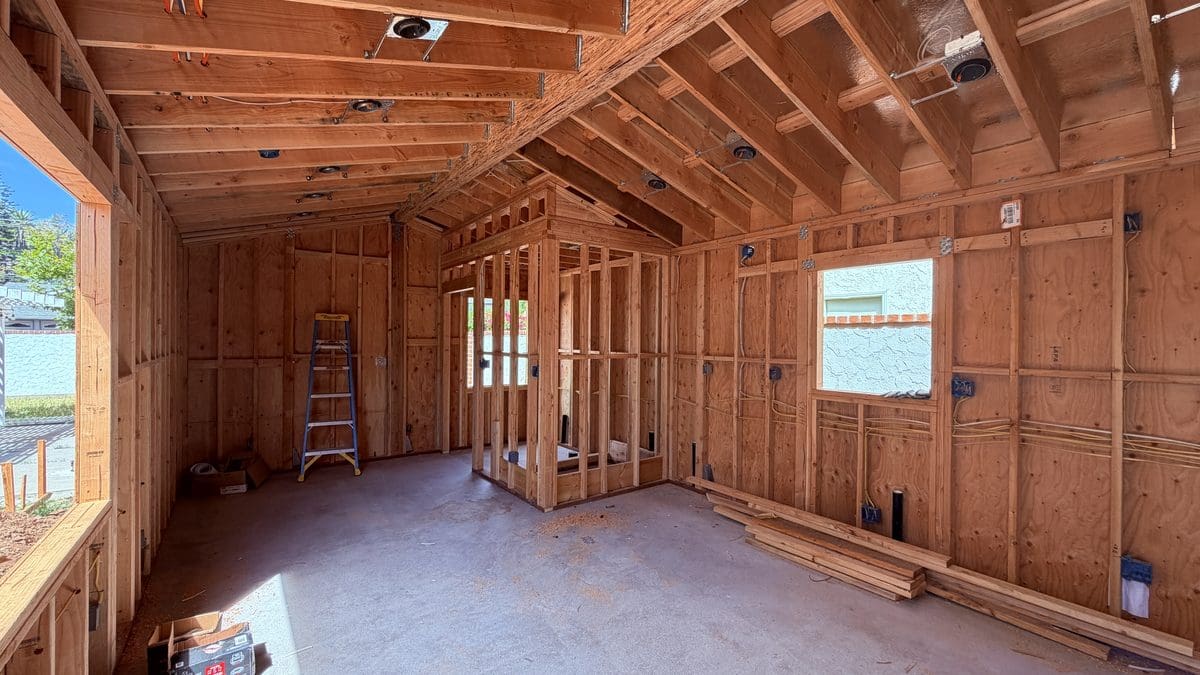
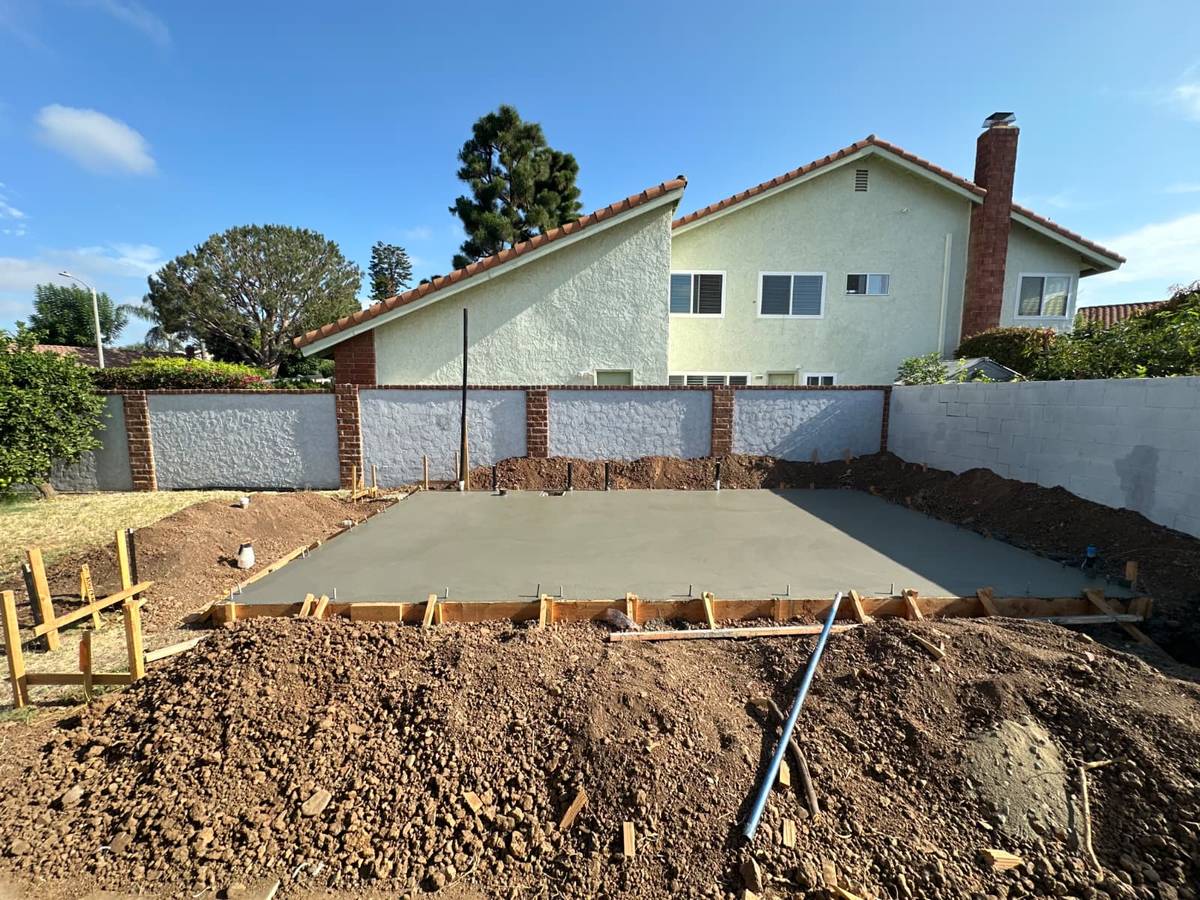

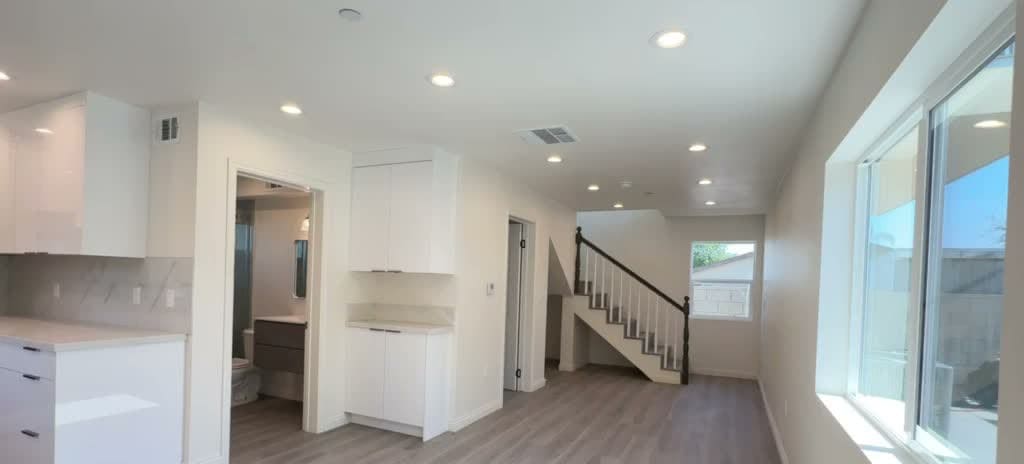
What does an ADU builder in Fullerton actually do?
An ADU design-build contractor in Fullerton right now has one extra job: designing against a 2025 ordinance that most online summaries have not caught up with. L Square reads Ordinance 3343 and the Building & Safety bulletins as they stand today, prepares the submittal to match, and builds through final inspection. When rental use is part of the decision, compare the property assumptions in our ADU ROI calculator.
Start with what your lot supports: our floor plans show the range, and the site decides. Compare the ADU cost guide before choosing between a detached build and a garage conversion ADU, and use the complete ADU guide for the sequence from feasibility to handover.
What is different about building an ADU in Fullerton?
The parking rule has a campus clause. Replacing the spaces a converted garage held is off the table entirely under Gov. Code 66314(d)(11), so the only question is the ADU’s own space. That is capped at one and uncovered is fine, and near CSUF it may be waived altogether, a nod to the reality that student tenants often do not bring cars. Whether your address qualifies is exactly the kind of thing we confirm before design, because it changes what fits on the lot.
The housing stock works in your favor. Like Santa Ana, much of Fullerton went up in an era of generous lots, which means the slab-and-panel questions of older garages apply, and so does the opportunity: plenty of parcels take a detached unit comfortably. For student rentals, a simple, durable two-bedroom detached unit is often the highest-yield play.
And think in semesters, not just leases. A unit ready for August 1st rents in days; the same unit finished in November waits for spring. When we schedule a Fullerton build, the academic calendar is genuinely part of the plan.
Fullerton’s ADU rules are newer than almost anything written about them: the city adopted Ordinance 3343 on June 17, 2025, and as the city itself notes, it is not yet codified into the municipal code. That has a practical consequence, anyone quoting “Fullerton municipal code” ADU standards from before mid-2025 may be quoting rules that no longer apply. The ordinance document itself, published on the city site, is the current authority, alongside the ADU guidelines in Building & Safety’s information bulletins. We read both before drawing anything here.
What does not change with the ordinance is the state floor underneath it: ministerial approval on the statutory clocks, four-foot side and rear setbacks for new detached construction, no minimum lot size, and the parking exemptions, half a mile from transit, conversions of existing space, and no replacement parking when a garage becomes the unit. Fullerton’s older housing stock north of Commonwealth carries exactly the kind of deep lots and detached garages that make both the conversion and the detached path viable; which one wins is a slab, panel and sewer question, answered by looking. The utilities guide covers what those three answers do to a budget.
Fullerton’s rental demand has an anchor most OC cities lack: Cal State Fullerton, one of the largest universities in the state, sits inside the city and keeps year-round pressure on small rentals. That shapes what we build here, one-bedroom units with real workspace rent easily to graduate students and university staff, and the tenant pool refreshes annually rather than churning unpredictably. It also shapes where: the tracts within a comfortable ride of campus carry a rental premium the western edge of the city does not.
The terrain deserves a word too. Fullerton is not uniformly flat, the northern neighborhoods toward the hills carry real slope, and slope is the single most expensive surprise in ADU construction: stepped foundations, retaining, drainage engineering. A lot in Raymond Hills prices differently from a lot near Commonwealth for the same floor plan, and no rule of thumb substitutes for standing on the parcel. That is why our quotes follow a site visit rather than an address, and why the cost guide quotes ranges instead of a single number.
Fullerton’s 2025 ordinance rewrite makes the neighbours a useful reference point while local summaries catch up. Anaheim next door offers ADU Express one-day permitting from a plan catalogue, which Fullerton has no equivalent of; Garden Grove publishes case-by-case handouts that are clearer than most. Fullerton’s distinguishing factor is demand rather than process: Cal State Fullerton keeps small rentals occupied year-round.
For the record, the 2025 rewrite was a zoning amendment rather than a new standalone chapter: on June 17, 2025 the City Council approved Ordinance No. 3343, amending Fullerton Municipal Code Title 15, Zoning, covering both accessory and junior accessory dwelling units. That matters when you are comparing sources, because a summary written against the pre-2025 Title 15 text is describing standards the council has since replaced. We work from the ordinance and from the ADU guidance in Building and Safety’s information bulletins, and we confirm the current version at the counter before drawing.
What does California law guarantee an ADU owner in Fullerton?
A city ordinance sits on top of state law, never underneath it. Four sections of the Government Code decide what Fullerton can and cannot require of your project. Each one links to the full text on the Legislature’s own site, so you can read the wording rather than take our summary for it.
| GOV §66316 | A local ADU ordinance may contain only ministerial provisions. That is why a code-compliant ADU in Fullerton gets no public hearing, no discretionary review and no neighbor veto. |
| GOV §66314 | Sets out what a local ordinance has to do, including designating where ADUs are allowed. It also carries the parking exemptions, so no replacement parking can be demanded when a garage becomes the unit. |
| GOV §66321 | A city may set minimum and maximum unit sizes, but it cannot impose a minimum square footage that blocks an ADU, and its maximum cannot be set below the state floor of 850 sq ft, or 1,000 sq ft for more than one bedroom. |
| GOV §66333 | Governs junior ADUs: up to 500 sq ft, created inside an existing single-family home, with a permit and a recorded deed restriction, and rented for terms longer than 30 days. |
If something a city asks for conflicts with these sections, the state text governs. That is worth knowing before you agree to redraw a plan set.
What does an ADU cost in Fullerton?
Standard county ranges ($90,000–$150,000 conversions, $200,000–$450,000+ detached) with a bias toward durable, low-maintenance finishes: student tenants are hard on units, and the $2,000–$2,500 rent band rewards toughness over polish. See the cost guide.
What actually decides the price on your lot?
Two identical floor plans on two Fullerton streets can price differently, and the reason is almost never the city. It is these seven site conditions, which is why we quote after standing on the property rather than from an address.
| Electrical panel | Whether the existing service can carry a second dwelling, or the job needs a subpanel and a service upgrade. |
| Sewer route and distance | The trench length from the unit to the existing lateral, and whether the fall works or a pump is required. |
| Gas | Whether gas gets extended to the unit or the design goes all-electric, which changes both the trenching and the equipment. |
| New meters | Whether the utility wants separate meters, and the lead time that adds to the schedule. |
| Demolition | What has to come out before anything goes in, and whether something undocumented is sitting behind it. |
| Slope | Stepped foundations, retaining and engineered drainage. This is the most expensive category of site surprise in Southern California. |
| Access | Whether a truck and equipment can reach the back of the lot, or every yard of concrete and every sheet of drywall is carried by hand. |
Published model prices and the full range by size are on the Orange County ADU cost guide. The seven items above are what turn that range into a number for your property.
What will your Fullerton lot allow?
Send the address and we will come back with what the lot allows and a free estimate.
What do Fullerton homeowners ask most often?
Is the parking requirement really waived near CSUF?
Are student tenants a good idea?
When should a Fullerton ADU be finished?
What does a Fullerton ADU rent for?
What changed in Fullerton’s 2025 ADU ordinance?
Where do I find Fullerton’s ADU requirements?
Do state ADU protections still apply in Fullerton?
Is a garage conversion practical in Fullerton?
Is a Fullerton ADU a good rental investment?
Does slope on my Fullerton lot change the ADU cost?
Do I need parking for a Fullerton ADU?
Can I build an ADU and a JADU together in Fullerton?
Does a Fullerton ADU raise my property taxes?
What exactly did Ordinance 3343 change?
How many ADUs are permitted in Fullerton each year?
Where can Fullerton homeowners check the rules themselves?
Ready to start
your ADU?
Get a free, no-pressure quote from a licensed Orange County design-build team, and a plan drawn around your lot.