

ADU Builder in Orange, CA: Standard Lots and Four Historic Districts
One city, two very different games: a standard state-law path on most lots, and four historic districts where your ADU needs a preservation professional before the city will look at it.
What should you know before building an ADU in Orange?
| Who reviews your plans | The City of Orange’s own Planning Division, with extra submittal rules inside its historic districts |
| The address question | Orange has four historic districts (Old Towne among them); inside one, an ADU triggers historic-preservation review |
| What that review needs | A report by a qualified historic-preservation professional plus conformance with the Old Towne design standards and a Minor Design Review application |
| Outside the districts | The normal state-law path: ministerial approval, 4-ft setbacks, the 2026 review clock |
| Old Towne is different | ADU work on historic properties needs a historic resource assessment against the Secretary of the Interior’s Standards |
| Design standards since 1995 | Old Towne’s Historic Preservation Design Standards have governed exterior changes for three decades |
| Fresh ordinance | The city updated its ADU ordinance in 2024 (Planning Commission Resolution 14-24) |
In Orange, the first question isn’t what you want to build, it’s where your lot sits. The city maintains four historic districts, including Old Towne, and its submittal rules are explicit: additions, infill and accessory dwelling units on property in a historic district require an evaluation prepared by a qualified historic-preservation professional, conformance with the Old Towne Historic Preservation Design Standards, and a Minor Design Review application. Outside the districts, Orange is a normal state-law city. Same town, two different projects, so we check the address before anything else.
How many ADUs actually get built in Orange?
Orange issued building permits for 88 ADUs in 2025, and 459 in total since 2018. These are the city’s own figures, filed with the State of California, not an estimate.
| Year | ADU building permits issued in Orange |
|---|---|
| 2018 | 10 |
| 2019 | 10 |
| 2020 | 39 |
| 2021 | 56 |
| 2022 | 83 |
| 2023 | 69 |
| 2024 | 104 |
| 2025 | 88 |
For scale: ADUs were 33.7% of every home permitted in Orange County in 2025 (about one in every three), and 25.9% of every home permitted statewide. Full city-by-city tables are on our California ADU statistics page.
Source: California Department of Housing and Community Development, Housing Element Annual Progress Report, Table A2, units with building permits issued. Retrieved August 2026.
What does an L Square ADU in Orange look like mid-build?
This one is on our boards as you read this. The slab was poured on 12 August 2026, the roof was framed by 15 August, and by 29 August the walls, interior partitions and rough electrical were in. Three weeks, our own crew, our own photos.
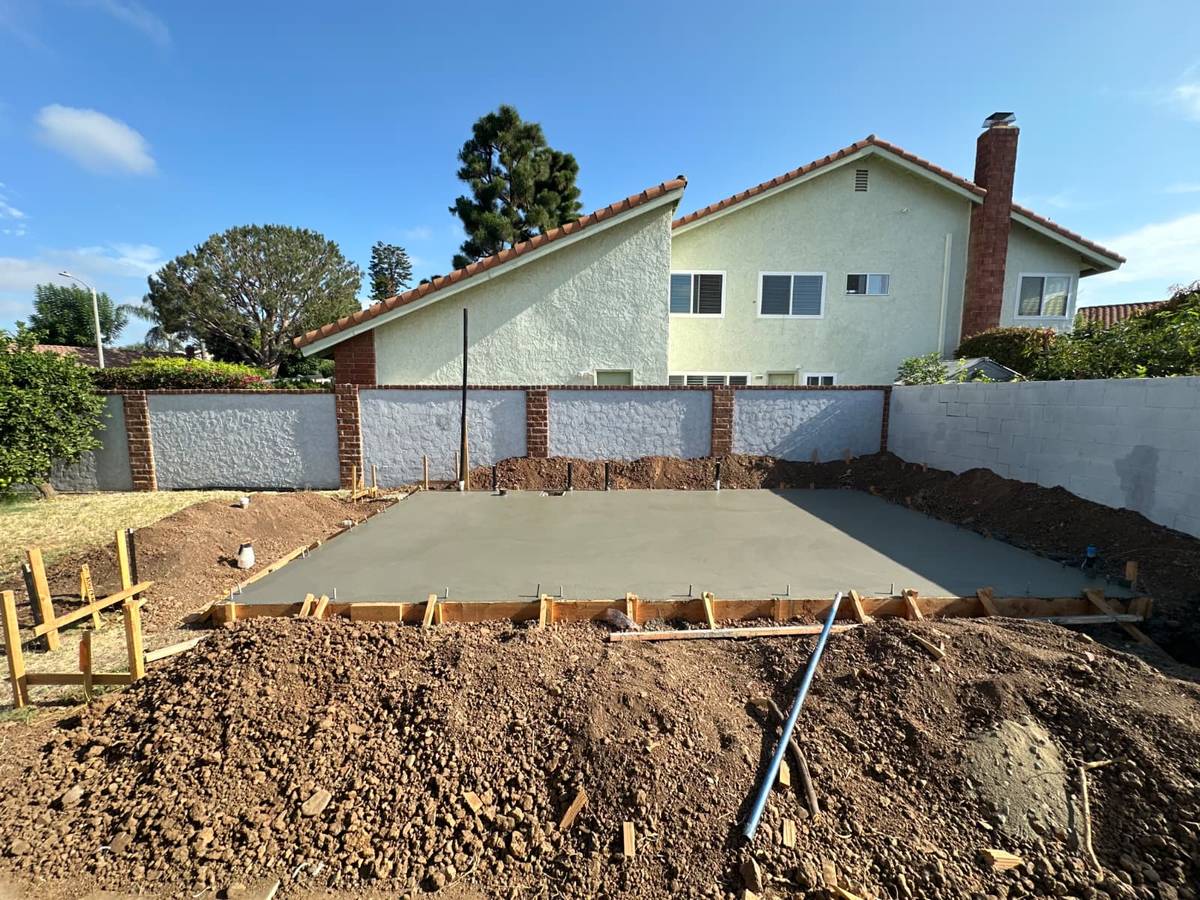
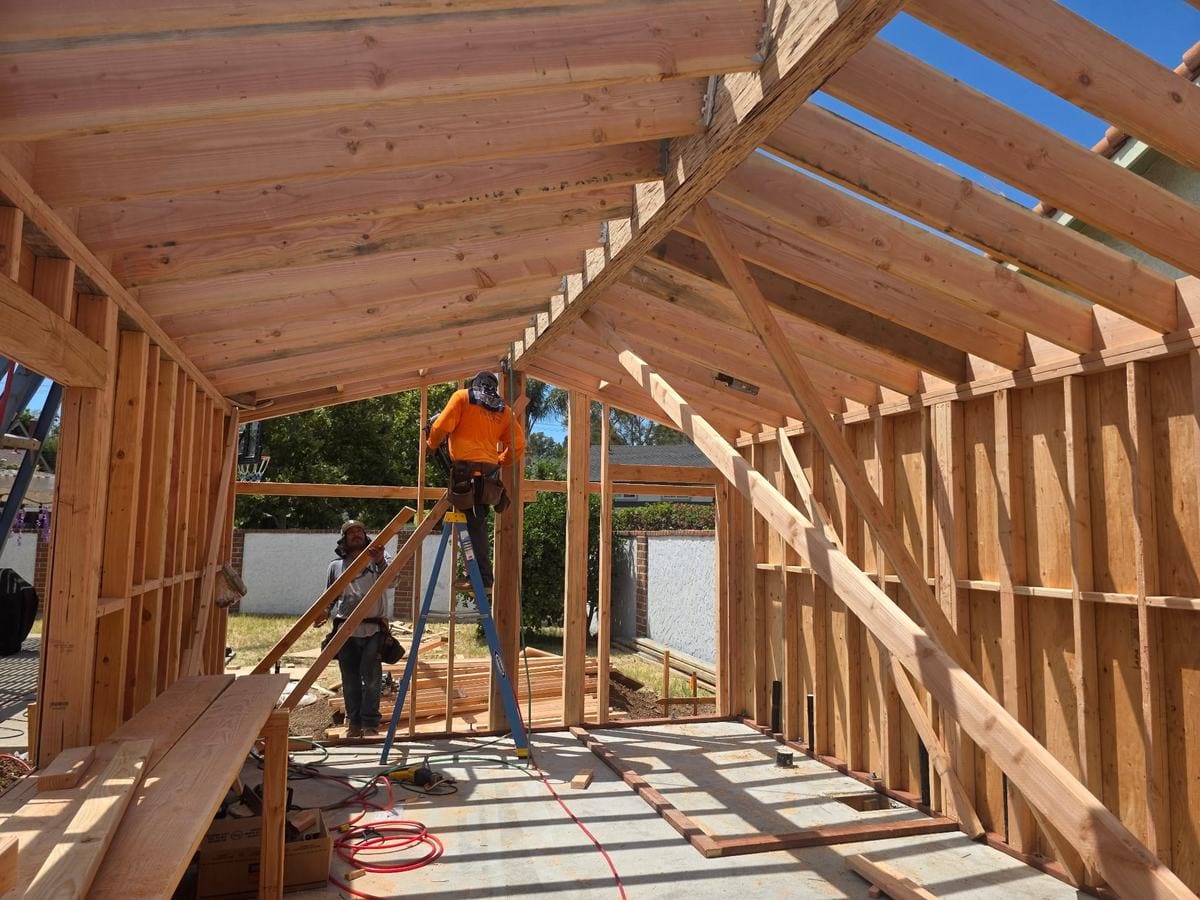
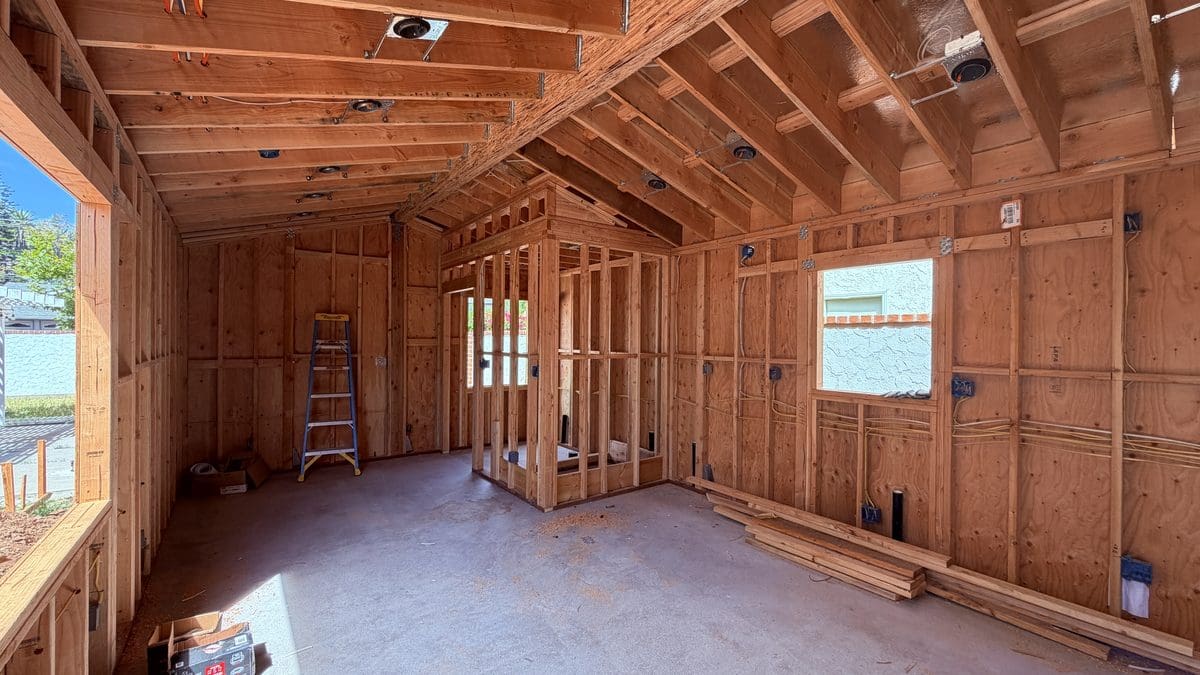
What does an ADU look like at each stage of the build?
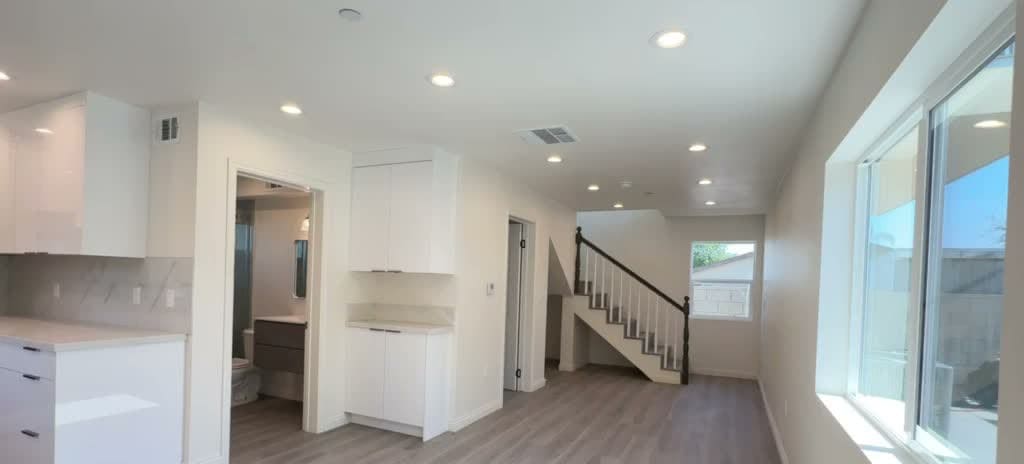
The photographs below are our own, taken on L Square job sites. Every caption states where and when the picture was taken. None of them are stock images or renderings, and none of them are presented as work in Orange unless the caption says so. The sequence is the same on every project: forms and rebar, the pour, the cured slab, then framing.
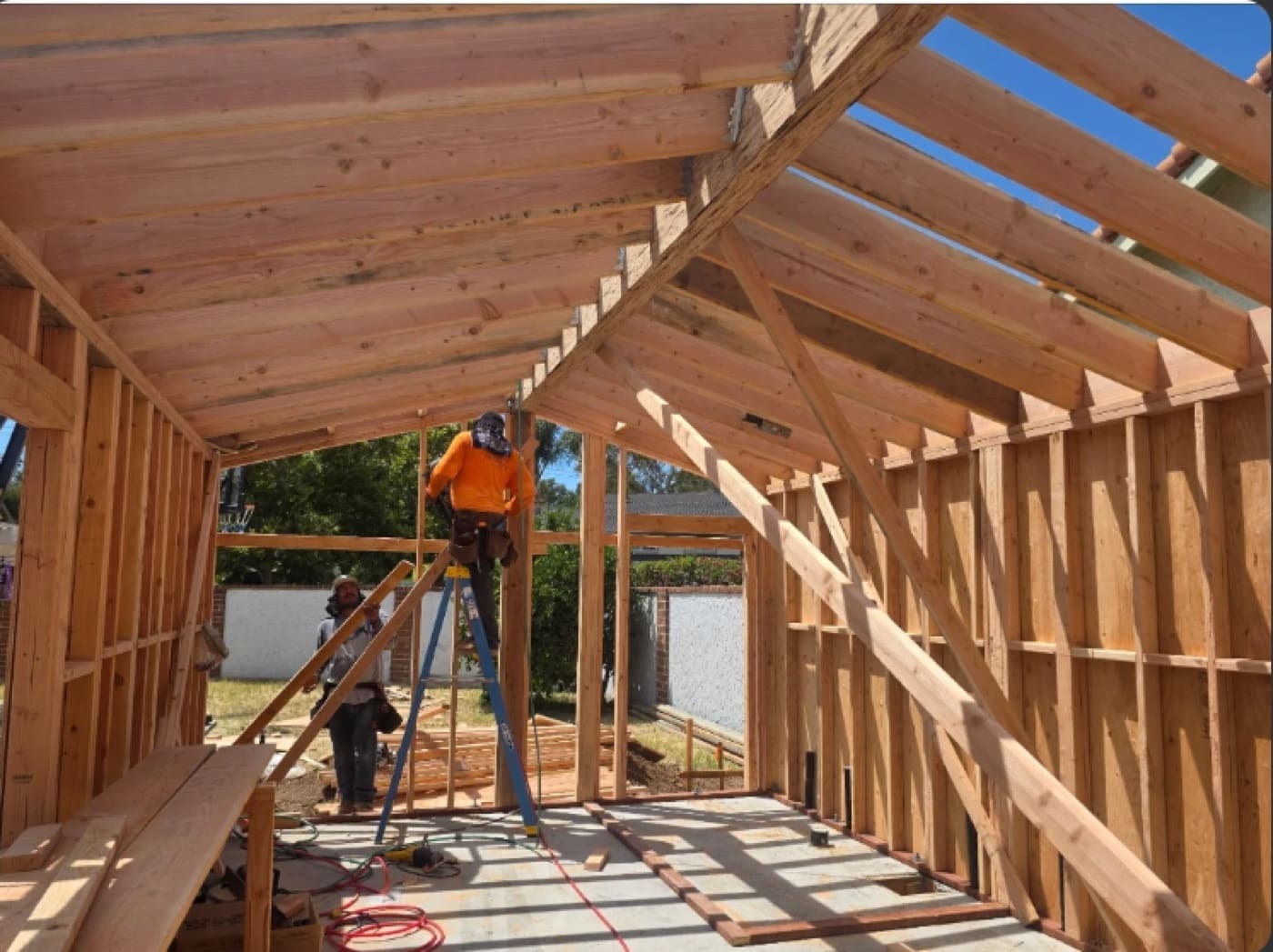


What does an ADU builder in Orange actually do?
An ADU design-build contractor in Orange needs two registers: standard ministerial work outside the district, and preservation-literate design inside Old Towne. L Square runs the assessment, designs to the standards and carries the project through review into construction. The construction process checklist helps place historic review before the permit package is finalized.
The district’s deep Victorian and Craftsman lots are some of the best ADU ground in the county once the design respects the setting. Compare the ADU cost guide before choosing between a detached build and a garage conversion ADU, and use the complete ADU guide for the sequence from feasibility to handover.
What is different about building an ADU in Orange?
If your lot is in a historic district, respect the process and it works. The city wants the new unit to sit quietly behind the historic house (materials, massing and rooflines that defer to the original structure), and it asks for a preservation professional’s report (the city keeps a list of qualified consultants) before plan check. That adds design time and a consultant fee, but it is not a veto: state ADU law still applies, and a well-designed rear-yard unit gets through. The mistake that costs money is submitting a standard plan set first and discovering the historic requirements as a correction.
Outside the four districts, Orange behaves like its neighbors: ministerial approval for a code-compliant unit, 4-foot side and rear setbacks, and the state review clock, 15 days to completeness, 60 days to a decision. The housing stock is a mix, from early-1900s bungalows near the core to postwar tracts further out, so the usual physical checkpoints (slab, panel, sewer run) decide the budget.
One planning note we give every Orange homeowner: if you are anywhere near a district boundary, don’t guess. The city’s maps are precise, the submittal requirements change completely across that line, and confirming it takes us minutes on the first visit.
Orange’s defining feature is Old Towne (one of the largest National Register historic districts in California), and the city treats it accordingly. An ADU project on a historic property includes a historic resource assessment evaluating the design against the Secretary of the Interior’s Standards for Rehabilitation and the city’s own Historic Preservation Design Standards, adopted in 1995. Exterior changes in the district run through design review, minor cases at staff level, substantial ones before the Design Review Committee. None of this stops an ADU; it decides what the ADU looks like and where on the lot it sits.
Two Old Towne specifics worth knowing. First, if a historic accessory structure (the old garage, the original barn) cannot reasonably be rehabilitated into the unit, city staff will work with you on alternatives that leave the historic structure alone and place the ADU elsewhere on the lot; the district rewards working with the fabric rather than against it. Second, the rules you will find quoted online may be stale: the city updated its ADU ordinance in 2024, so we verify against the current text rather than a blog summary. Outside the district, Orange processes ADUs on the standard ministerial track like its neighbors.
Outside Old Towne, Orange behaves like its neighbours; inside it, nothing else in the county compares. Anaheim next door offers one-day catalogue permitting with no historic layer at all, and Santa Ana excludes its own historic districts from the pre-approved path rather than adding review to them. If your parcel sits just outside the district boundary, the process is dramatically simpler, and confirming which side you are on takes minutes.
The historic-district requirement is now written down, and it is more demanding than a design review. For construction involving a historic property or any property inside one of the city’s four historic districts, and the requirement names accessory dwelling units specifically, a land use application must include an evaluation of existing conditions and of the project’s compliance with the Secretary of the Interior’s Standards for Rehabilitation together with the applicable city historic preservation design standards. For a non-contributing property inside a district, the evaluation instead addresses potential impacts on the integrity of the district. That is preservation-professional work, and budgeting for it at the start is what keeps an Old Towne project on schedule.
What does California law guarantee an ADU owner in Orange?
A city ordinance sits on top of state law, never underneath it. Four sections of the Government Code decide what Orange can and cannot require of your project. Each one links to the full text on the Legislature’s own site, so you can read the wording rather than take our summary for it.
| GOV §66316 | A local ADU ordinance may contain only ministerial provisions. That is why a code-compliant ADU in Orange gets no public hearing, no discretionary review and no neighbor veto. |
| GOV §66314 | Sets out what a local ordinance has to do, including designating where ADUs are allowed. It also carries the parking exemptions, so no replacement parking can be demanded when a garage becomes the unit. |
| GOV §66321 | A city may set minimum and maximum unit sizes, but it cannot impose a minimum square footage that blocks an ADU, and its maximum cannot be set below the state floor of 850 sq ft, or 1,000 sq ft for more than one bedroom. |
| GOV §66333 | Governs junior ADUs: up to 500 sq ft, created inside an existing single-family home, with a permit and a recorded deed restriction, and rented for terms longer than 30 days. |
If something a city asks for conflicts with these sections, the state text governs. That is worth knowing before you agree to redraw a plan set.
What does an ADU cost in Orange?
Published ranges apply in Orange: garage conversions typically $90,000–$150,000, detached units $200,000–$450,000+. In a historic district, add the preservation consultant’s report and design-review time to the plan, a real line item, not a rounding error. Details in the cost guide.
What actually decides the price on your lot?
Two identical floor plans on two Orange streets can price differently, and the reason is almost never the city. It is these seven site conditions, which is why we quote after standing on the property rather than from an address.
| Electrical panel | Whether the existing service can carry a second dwelling, or the job needs a subpanel and a service upgrade. |
| Sewer route and distance | The trench length from the unit to the existing lateral, and whether the fall works or a pump is required. |
| Gas | Whether gas gets extended to the unit or the design goes all-electric, which changes both the trenching and the equipment. |
| New meters | Whether the utility wants separate meters, and the lead time that adds to the schedule. |
| Demolition | What has to come out before anything goes in, and whether something undocumented is sitting behind it. |
| Slope | Stepped foundations, retaining and engineered drainage. This is the most expensive category of site surprise in Southern California. |
| Access | Whether a truck and equipment can reach the back of the lot, or every yard of concrete and every sheet of drywall is carried by hand. |
Published model prices and the full range by size are on the Orange County ADU cost guide. The seven items above are what turn that range into a number for your property.
What will your Orange lot allow?
Send the address and we will come back with what the lot allows and a free estimate.
What do Orange homeowners ask most often?
Can I build an ADU in Old Towne Orange?
How do I know if my Orange property is in a historic district?
Does an ADU in Orange need a public hearing?
What does the historic-district requirement cost?
Can I build an ADU in Old Towne Orange?
What is a historic resource assessment?
My Old Towne garage is falling down. Can it become the ADU?
Are Orange’s ADU rules current online?
Do I need parking for an ADU in Orange?
How big can my Orange ADU be?
Does an Orange ADU need fire sprinklers?
What does a historic-district ADU application need in Orange?
How many ADUs are permitted in Orange each year?
Where can Orange homeowners check the rules themselves?
Ready to start
your ADU?
Get a free, no-pressure quote from a licensed Orange County design-build team, and a plan drawn around your lot.