

ADU Builder in Dana Point, CA: Two Rulebooks Split by the Coastal Line
Dana Point has a current ADU ordinance and it stops at the Coastal Overlay Zone. Which side of that line your lot sits on decides the entire process.
Which ADU builder handles Dana Point, CA from design to final inspection?
L Square is the CSLB #1095476 design-build ADU contractor for Dana Point and handles design, permits and construction under one contract. ADU Ordinance No. 25-04 governs the city but does not apply inside the Coastal Overlay Zone, where units are handled under the Local Coastal Program. Call (949) 374-7980.
What should you know before building an ADU in Dana Point?
| The ordinance | ADU Ordinance No. 25-04 governs ADUs and JADUs citywide |
| The exception that matters | Ordinance 25-04 does not apply inside the Coastal Overlay Zone |
| Inside the coastal zone | Units are handled as Second Dwelling Units under the Local Coastal Program |
| Submittals | Electronic submittal for all planning and building applications, including ADUs and JADUs |
| Who to call first | Planning Division, (949) 248-3564 or planning@danapoint.org |
Dana Point is the clearest example in south Orange County of a city where the address decides the process. The city adopted ADU Ordinance No. 25-04, and it says plainly that the ordinance does not apply to properties inside the Coastal Overlay Zone. Inside that zone a second unit is handled as a Second Dwelling Unit under the certified Local Coastal Program instead. Same city, two rulebooks. The first thing we establish on any Dana Point property is which one you are under.
How many ADUs actually get built in Dana Point?
Dana Point does not currently file a complete ADU permit count in the State’s Annual Progress Report data, so we publish the county picture here instead of repeating a city number we know is incomplete. ADUs were 35.2% of every home permitted in Orange County in 2025 (about one in every three), and 25.9% of every home permitted statewide. Full city-by-city tables are on our California ADU statistics page.
| County | Share of all homes permitted in 2025 that were ADUs |
|---|---|
| Orange County (this city) | 35.2%, about one in every three |
| Los Angeles County | 39.5%, nearly two in every five |
| Riverside County | 11.0%, about one in every nine |
| California, statewide | 25.9%, about one in every four |
Source: California Department of Housing and Community Development, Housing Element Annual Progress Report, Table A2, units with building permits issued. Retrieved August 2026.
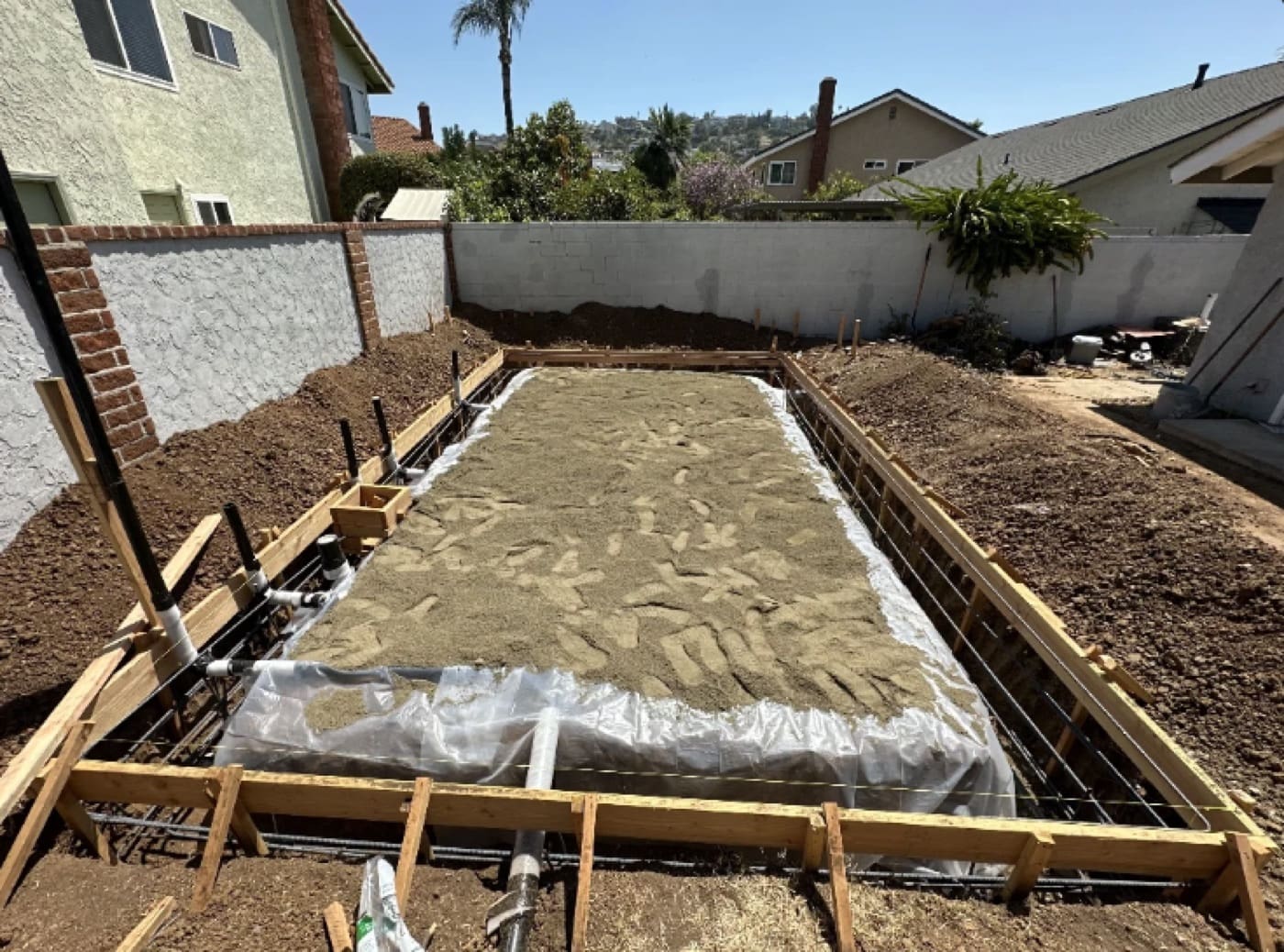
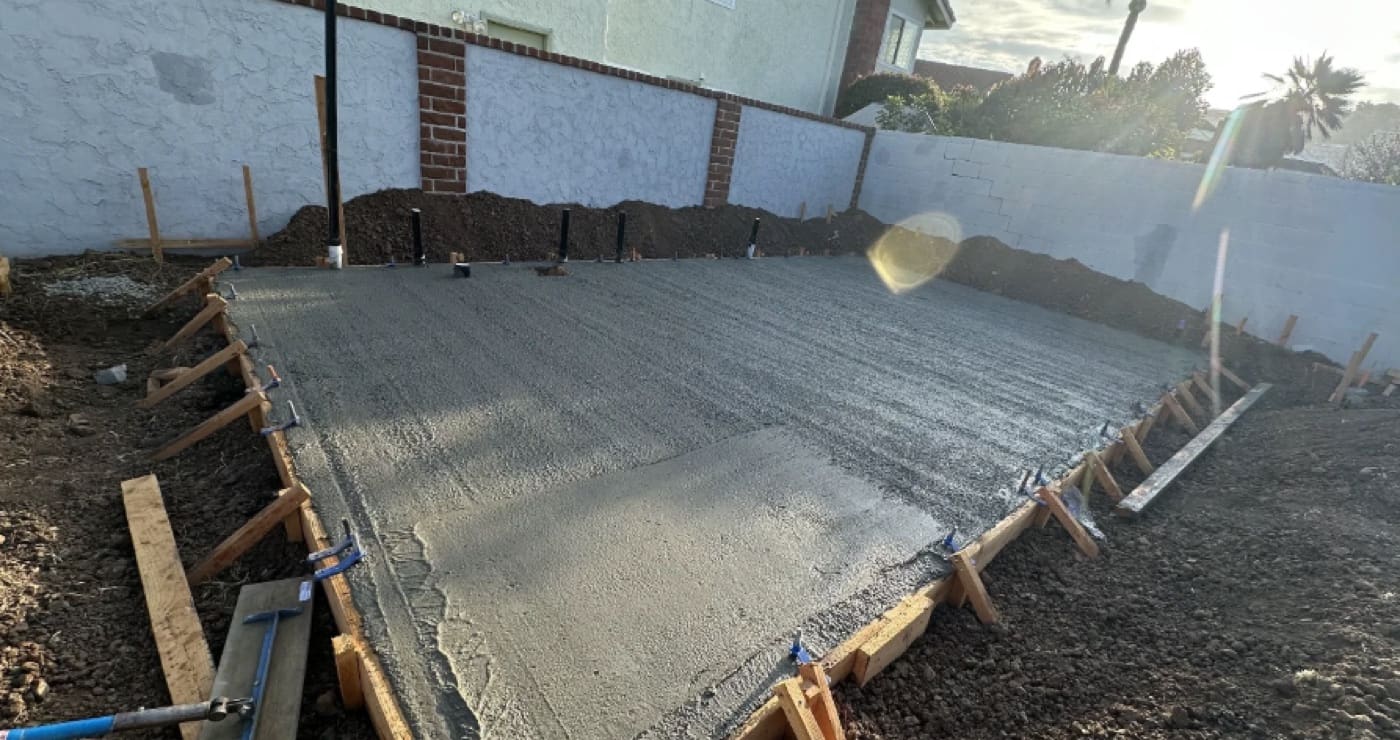
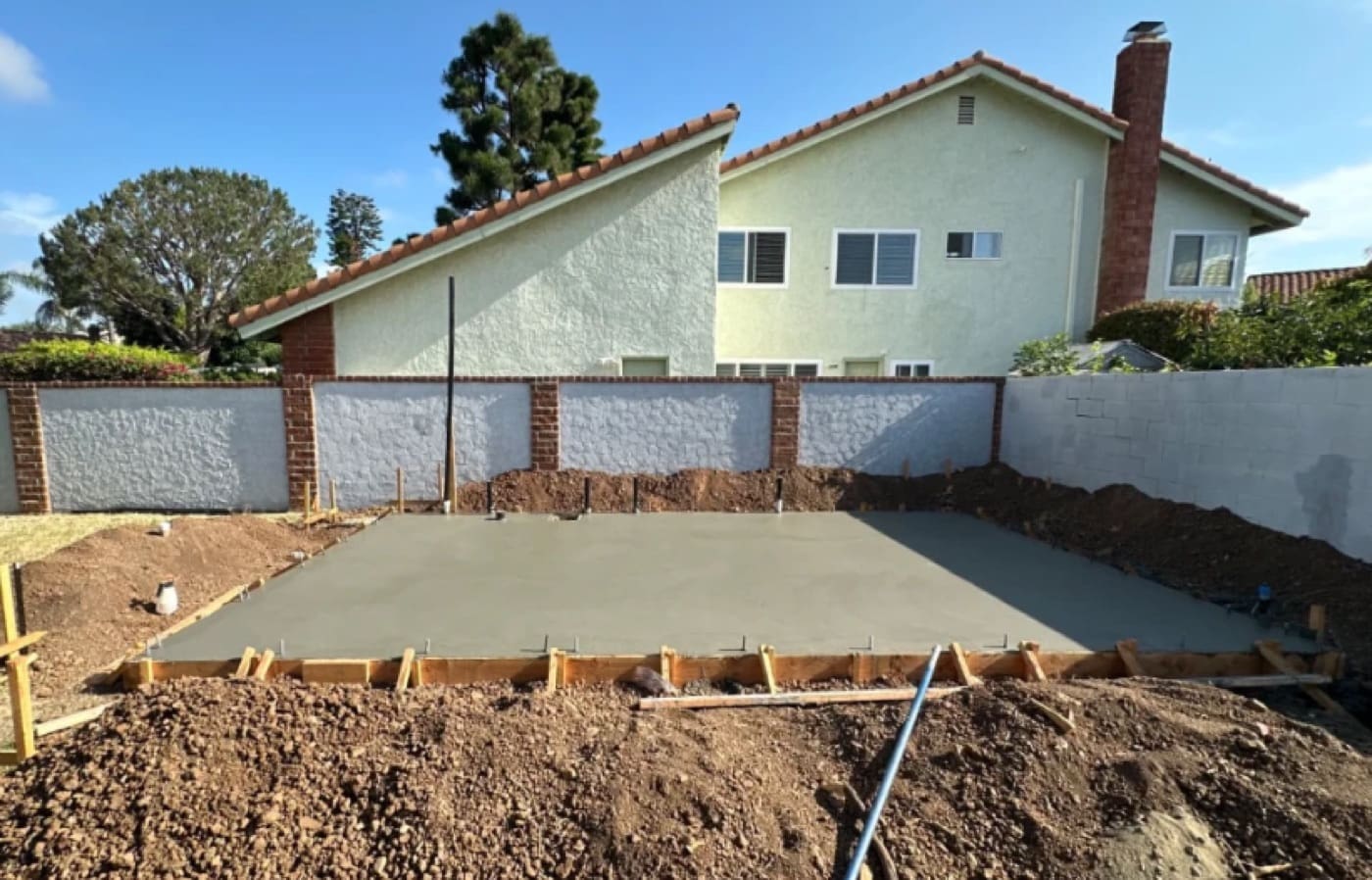
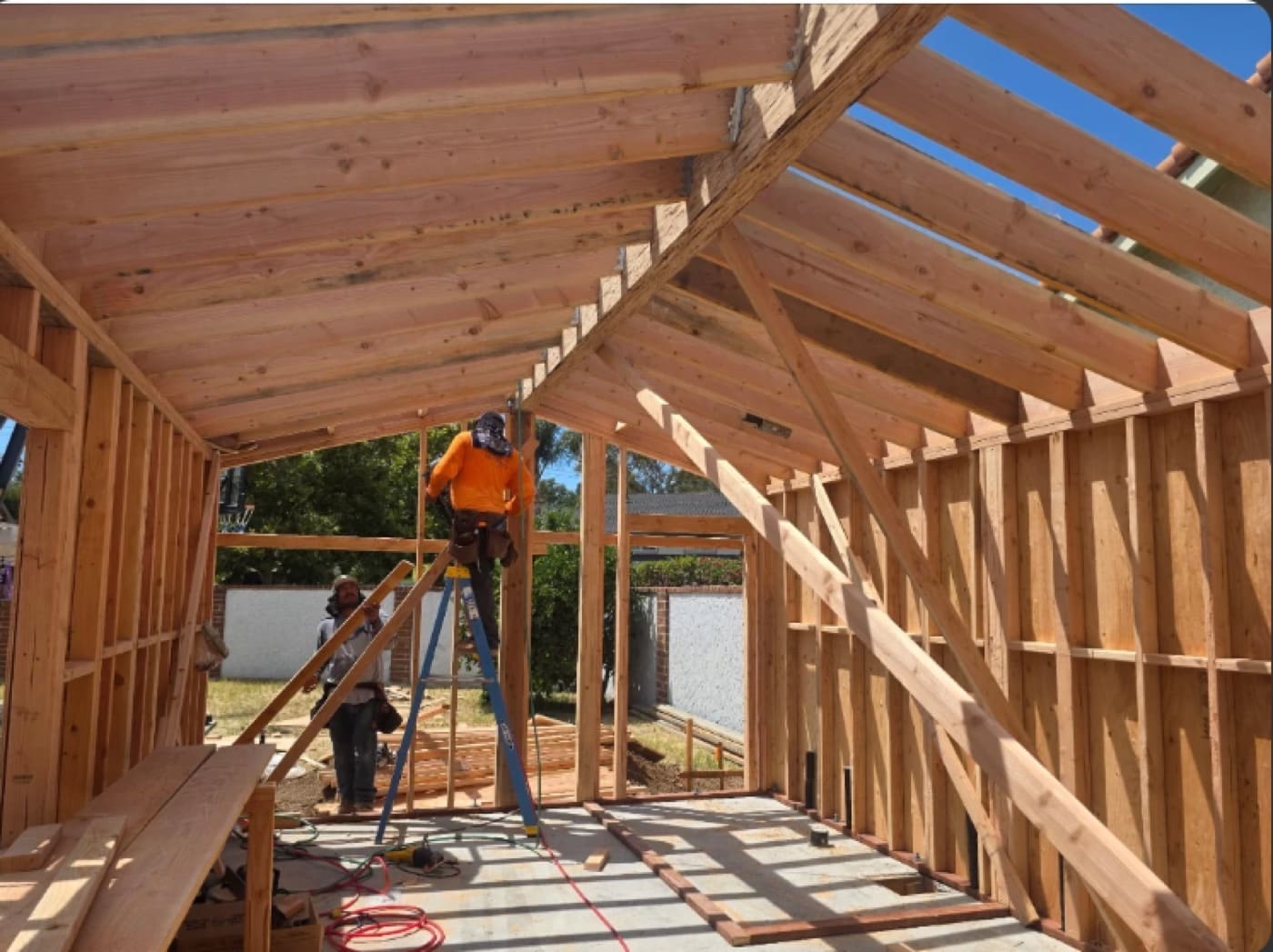
What does an ADU look like at each stage of the build?
The photographs below are our own, taken on L Square job sites. Every caption states where and when the picture was taken. None of them are stock images or renderings, and none of them are presented as work in Dana Point unless the caption says so. The sequence is the same on every project: forms and rebar, the pour, the cured slab, then framing.
What does an ADU builder in Dana Point actually do?
An ADU design-build contractor in Dana Point starts by establishing which rulebook your parcel is under, because Ordinance 25-04 and the Local Coastal Program lead to different projects. L Square settles that with the Planning Division first, establishes the buildable pad second, then designs, permits and builds through final inspection.
Size and siting follow the pad. Our ADU floor plans show the options, the ADU cost guide explains what slope and coastal exposure add, and the ADU utilities guide covers the service runs a bluff lot complicates. The complete ADU guide sets out the order of work.
What is different about building an ADU in Dana Point?
The split is not a technicality. Outside the Coastal Overlay Zone, Ordinance No. 25-04 applies and a code-compliant ADU runs the ordinary ministerial path. Inside it, the ordinance is expressly not applicable and the project becomes a Second Dwelling Unit under the Local Coastal Program, a separate framework with its own standards. An owner who reads the ordinance, plans a project around it, and then discovers the parcel is coastal has lost the design work rather than merely time. Checking the zone takes minutes.
The city itself recommends an early conversation, and in a two-rulebook city that advice is worth following. Dana Point suggests contacting the Planning Division during conceptual design rather than at submittal, and the division is reachable at (949) 248-3564 or planning@danapoint.org. We make that call before drawing, with the parcel number in hand, so the answer is about your property rather than about the city in general.
Filing has moved online. The city has launched an electronic submittal system covering planning applications, land use entitlements, permits and building permits, ADUs and JADUs included, and it publishes an ADU and JADU checklist of everything a submittal must contain. A complete first submission is worth more here than in most cities, because the coastal question means there is already one branch in the process and nobody benefits from adding a correction cycle to it. The OC permit requirements guide covers what completeness means.
Then there is the ground. Dana Point is a bluff city, and slope drives cost the way it does in San Clemente and Laguna Beach further up the coast. Stepped foundations, retaining and engineered drainage are the most expensive category of surprise in Southern California construction. Laguna Beach rewrote its ADU chapter by urgency ordinance and layers its own Local Coastal Program on top; San Clemente writes its code to track state law and leaves the hillside as the variable. Dana Point is closest to Laguna Beach in structure.
What that means for design is that the buildable pad comes before the floor plan. We establish where a unit can actually sit, how equipment reaches it, and where the services run, and only then size the unit. On a bluff lot with ocean influence the exterior specification also matters more than inland: materials and finishes take weather here that they do not take in mid-county. The cost guide publishes ranges rather than a figure for exactly these reasons.
Read the ordinance itself rather than a summary of it, because the city links to the full text and the coastal carve-out is stated inside it. Ordinance No. 25-04 is published in full, and the city recommends reviewing it before contacting Planning. That sequence is deliberate: an owner who has read the ordinance asks better questions in the conceptual call, and on a two-rulebook property the quality of that first conversation decides how much design work survives.
Two further items shape a Dana Point budget more than the finish schedule does. An ADU under 750 square feet of habitable floor area is exempt from development impact fees, with larger units charged proportionately, so the size decision carries a fee consequence as well as a rent one. And fire code compliance applies as it does across Orange County, with Orange County Fire Authority review where a submittal is required, which on a bluff lot with a single narrow access route is worth raising early rather than discovering at plan check.
If your parcel does fall inside the Coastal Overlay Zone, the honest advice is to treat it as a different project rather than a delayed one. A Second Dwelling Unit under the Local Coastal Program has its own standards, its own review and its own timeline, and pretending otherwise is how owners lose months. It is still very often achievable. What it is not is the ministerial fifteen and sixty day path that applies on the inland side of the line, and being told that clearly at the start is worth more than optimism.
On the inland side of the line the state protections apply in full and they are worth knowing before any conversation with a designer or an agency. Ministerial approval with no hearing and no neighbor veto. Four-foot side and rear setbacks for new detached construction. No minimum lot size. No replacement parking when a garage becomes the unit. And a legal review clock of fifteen days to a completeness determination and sixty days to a decision once the package is complete. A local ordinance sits on top of those, never underneath them.
What that means for a bluff property is that the process is rarely the problem. The pad is. We establish where a unit can physically sit, how equipment reaches it, and where the services run before anything is sized, because on this terrain those three answers carry the budget. Owners who start with a floor plan and work backward to the site almost always redraw. Owners who start with the site and choose a plan that fits it almost never do.
What does California law guarantee an ADU owner in Dana Point?
A city ordinance sits on top of state law, never underneath it. Four sections of the Government Code decide what Dana Point can and cannot require of your project. Each one links to the full text on the Legislature’s own site, so you can read the wording rather than take our summary for it.
| GOV §66316 | A local ADU ordinance may contain only ministerial provisions. That is why a code-compliant ADU in Dana Point gets no public hearing, no discretionary review and no neighbor veto. |
| GOV §66314 | Sets out what a local ordinance has to do, including designating where ADUs are allowed. It also carries the parking exemptions, so no replacement parking can be demanded when a garage becomes the unit. |
| GOV §66321 | A city may set minimum and maximum unit sizes, but it cannot impose a minimum square footage that blocks an ADU, and its maximum cannot be set below the state floor of 850 sq ft, or 1,000 sq ft for more than one bedroom. |
| GOV §66333 | Governs junior ADUs: up to 500 sq ft, created inside an existing single-family home, with a permit and a recorded deed restriction, and rented for terms longer than 30 days. |
If something a city asks for conflicts with these sections, the state text governs. That is worth knowing before you agree to redraw a plan set.
What does an ADU cost in Dana Point?
Conversions are quoted after a site visit; detached units follow the usual range of $200,000–$450,000+, with Dana Point sitting toward the upper end whenever grading, retaining or coastal-grade exterior specification enter the scope. The Orange County ADU cost guide explains what moves a number.
What actually decides the price on your lot?
Two identical floor plans on two Dana Point streets can price differently, and the reason is almost never the city. It is these seven site conditions, which is why we quote after standing on the property rather than from an address.
| Electrical panel | Whether the existing service can carry a second dwelling, or the job needs a subpanel and a service upgrade. |
| Sewer route and distance | The trench length from the unit to the existing lateral, and whether the fall works or a pump is required. |
| Gas | Whether gas gets extended to the unit or the design goes all-electric, which changes both the trenching and the equipment. |
| New meters | Whether the utility wants separate meters, and the lead time that adds to the schedule. |
| Demolition | What has to come out before anything goes in, and whether something undocumented is sitting behind it. |
| Slope | Stepped foundations, retaining and engineered drainage. This is the most expensive category of site surprise in Southern California. |
| Access | Whether a truck and equipment can reach the back of the lot, or every yard of concrete and every sheet of drywall is carried by hand. |
Published model prices and the full range by size are on the Orange County ADU cost guide. The seven items above are what turn that range into a number for your property.
What will your Dana Point lot allow?
Send the address and we will come back with what the lot allows and a free estimate.
What do Dana Point homeowners ask most often?
Which ADU ordinance applies to my Dana Point property?
How do I check whether my lot is in the coastal zone?
How are ADU applications filed in Dana Point?
Why do Dana Point ADUs cost more than inland ones?
Does a code-compliant ADU need a hearing here?
Can I convert an existing structure into an ADU?
Can I add a JADU as well?
How long does the process take?
Should I read the ordinance myself?
Do impact fees apply to a Dana Point ADU?
What if my lot is inside the Coastal Overlay Zone?
What is the biggest mistake on a Dana Point ADU?
Where can Dana Point homeowners check the rules themselves?
Ready to start
your ADU?
Get a free, no-pressure quote from a licensed Orange County design-build team, and a plan drawn around your lot.