

ADU Builder in Fountain Valley, CA: Flat Tract Lots, Published Standards
“A Nice Place to Live” is also a nice place to build: flat tract lots, published development standards, and a city that documents its rules clearly.
What should you know before building an ADU in Fountain Valley?
| Who reviews your plans | Fountain Valley’s Community Development department at City Hall on Slater Avenue |
| The city’s homework | Fountain Valley publishes its own ADU development-standards handout and a documents library. The rules are written down, not discovered at the counter |
| The terrain | Famously flat, orderly tract lots, the cheapest kind of ground to build a foundation on |
| State-law floor | Ministerial approval, 4-ft setbacks, and the 2026 SB 543 review clock all apply |
Fountain Valley is one of Orange County’s most orderly places to build. The city publishes its ADU development standards as a handout with a documents library to match, the tract lots are flat and regular, and the housing stock (single-story homes with real backyards and garages) suits every ADU type. When the rules are written down and the ground is flat, budgets behave.
How many ADUs actually get built in Fountain Valley?
Fountain Valley issued building permits for 65 ADUs in 2025, and 422 in total since 2018. These are the city’s own figures, filed with the State of California, not an estimate.
| Year | ADU building permits issued in Fountain Valley |
|---|---|
| 2018 | 13 |
| 2019 | 23 |
| 2020 | 38 |
| 2021 | 45 |
| 2022 | 58 |
| 2023 | 85 |
| 2024 | 95 |
| 2025 | 65 |
For scale: ADUs were 33.7% of every home permitted in Orange County in 2025 (about one in every three), and 25.9% of every home permitted statewide. Full city-by-city tables are on our California ADU statistics page.
Source: California Department of Housing and Community Development, Housing Element Annual Progress Report, Table A2, units with building permits issued. Retrieved August 2026.
What does an ADU look like at each stage of the build?
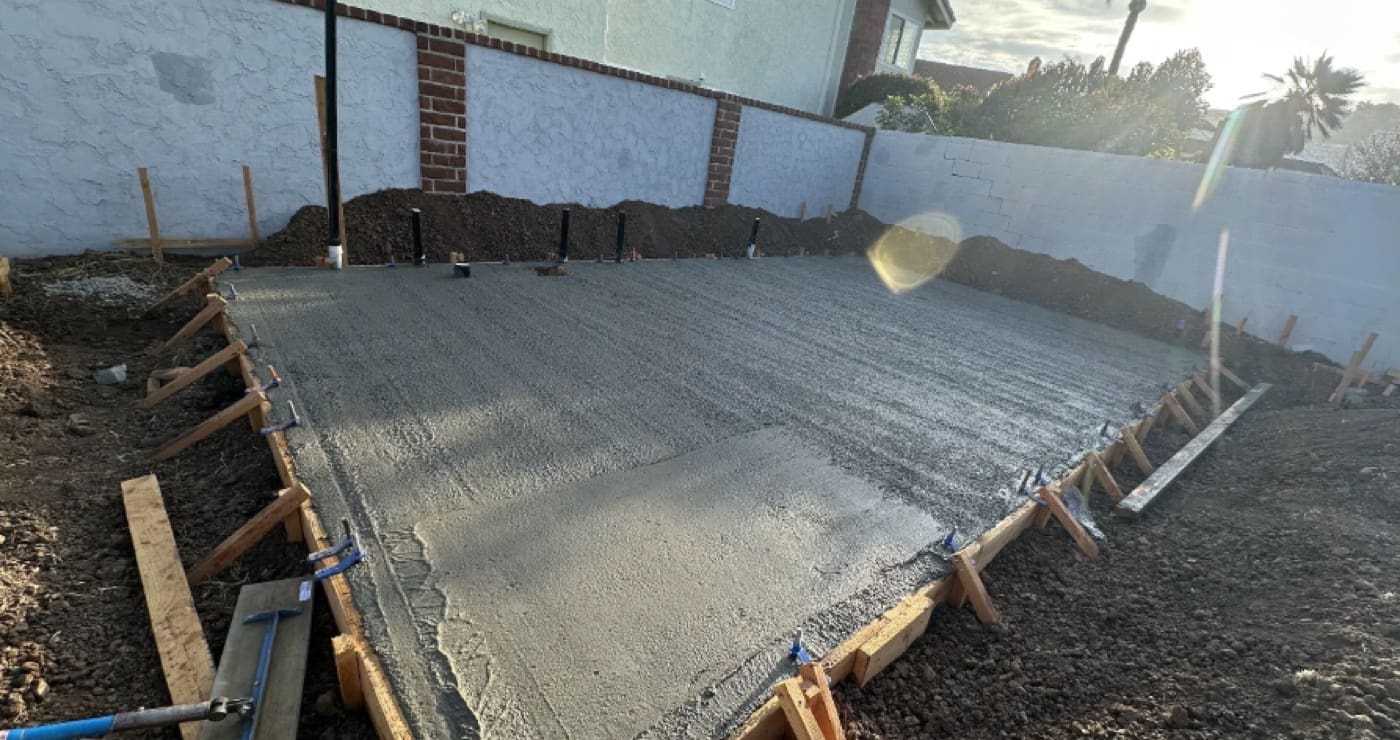
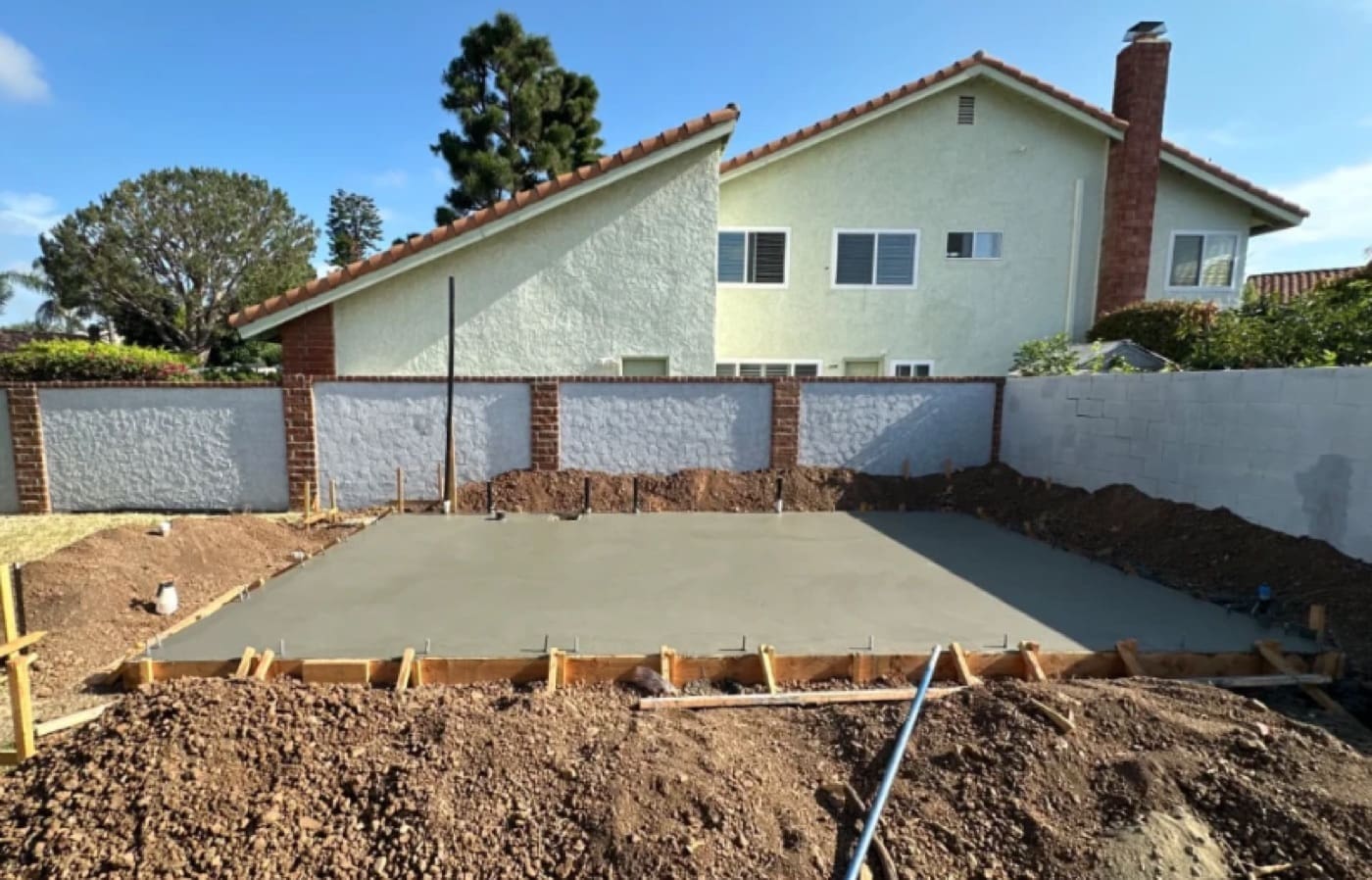
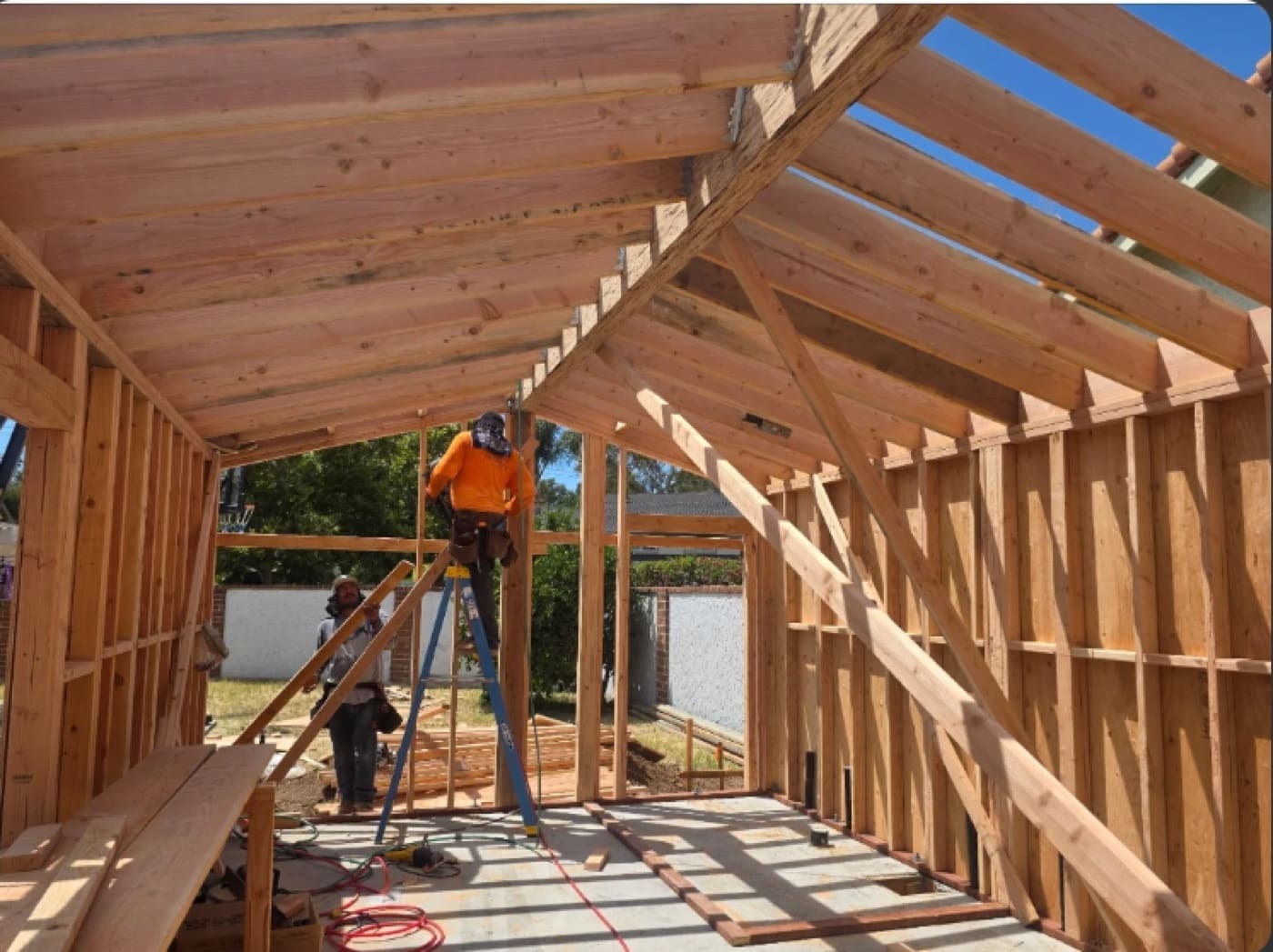
The photographs below are our own, taken on L Square job sites. Every caption states where and when the picture was taken. None of them are stock images or renderings, and none of them are presented as work in Fountain Valley unless the caption says so. The sequence is the same on every project: forms and rebar, the pour, the cured slab, then framing.

What does an ADU builder in Fountain Valley actually do?
An ADU design-build contractor in Fountain Valley should be designing to the city’s published standards from the first sketch. L Square reads the ADU handout, matches the plan set to it, submits, and builds through final inspection as one team, so the plan check confirms the design instead of correcting it.
Decide the unit before the budget hardens. The ADU floor plans page shows what fits a flat tract lot, the ADU cost guide carries the ranges, and the garage conversion ADU guide covers the conversion route. The complete ADU guide is the step-by-step version.
What is different about building an ADU in Fountain Valley?
Start with the city’s own paperwork. Fountain Valley maintains a published ADU development-standards handout, setbacks, size and the local implementation of state law in one document. We design to it from the first sketch, because a plan set that matches the published standards moves through review without the correction rounds that stall projects elsewhere.
The flat-lot advantage is real money. Slope is one of the seven site factors that genuinely move an ADU budget, and Fountain Valley’s famously level tracts take that variable off the table for most addresses: simple pad, simple drainage, simple foundation. What’s left is the usual trio we inspect everywhere, slab, electrical panel, sewer run.
The lots themselves are generous by mid-county standards, which keeps both classic paths open: convert the garage that’s already standing, or place a detached unit where the yard and utility runs make sense. On several Fountain Valley streets the same floor plan we build in Huntington Beach drops in with almost no site adaptation, which is exactly the kind of boring that saves owners money.
Set Fountain Valley beside the cities either side of it and the pattern is clear. Huntington Beach adds a coastal-zone question that can reshape a schedule, and Westminster routes owners through a pre-approved plan program and an online portal. Fountain Valley does neither. It publishes its standards and reviews to them, which is why the projects we run here tend to be the ones that finish closest to their original budget.
That predictability changes what is worth designing. When the ground is flat and the standards are on paper, the money is better spent on the unit than on site work, so a Fountain Valley budget can carry a real kitchen and a proper mini-split instead of retaining walls. The ADU floor plans page shows which layouts suit these lot widths.
The city publishes two documents that decide most of your design, and both are downloadable from its ADU documents page: an Accessory Dwelling Unit Handbook and a separate Development Standards for Accessory Dwelling Units sheet. Between them they cover setbacks, height, size and how Fountain Valley applies the state rules locally. We read both before drawing, which is the difference between a plan check that confirms a design and one that corrects it.
Flat ground changes where the money goes. On a level tract lot the foundation is a simple pad, the drainage is straightforward, and the excavation is short. That removes the single most expensive category of site surprise in Southern California and leaves the three physical questions we ask on every property: slab condition, electrical panel capacity, and the run from the unit to the sewer lateral. The ADU utilities guide covers what each of those does to a budget, and the construction checklist shows when each gets answered.
Fountain Valley’s lot pattern also keeps both paths genuinely open, which is less common than it sounds. Many mid-county parcels force the choice: the yard is too tight for a detached unit, or the garage is too poor to convert. Here the yards are usually deep enough for a detached build and the garages are usually sound enough to convert, so the decision is about what you want rather than what the site will tolerate. A detached unit rents higher and keeps the garage; a garage conversion costs less and finishes sooner. We price both before recommending either.
The state review clock is worth knowing by heart, because it is what turns a published standard into a schedule. A code-compliant ADU is approved ministerially, and since 2026 the city has 15 days to tell you whether the application is complete and 60 days to decide once it is. Neither clock starts on an incomplete package. That is the whole argument for designing to the city’s published standards from the first sketch rather than submitting and negotiating.
One more Fountain Valley specific: single-story homes with attached garages are common here, which makes the ADU plus JADU pairing unusually practical. State law allows one ADU plus one junior ADU of up to 500 square feet created inside the existing house. On a typical lot here that means a detached unit in the back yard and a JADU carved out of a bedroom and bath at the front of the house, two rentable units without approaching lot coverage limits. The junior ADU guide covers the deed restriction and the owner-occupancy rules that come with it.
What does California law guarantee an ADU owner in Fountain Valley?
A city ordinance sits on top of state law, never underneath it. Four sections of the Government Code decide what Fountain Valley can and cannot require of your project. Each one links to the full text on the Legislature’s own site, so you can read the wording rather than take our summary for it.
| GOV §66316 | A local ADU ordinance may contain only ministerial provisions. That is why a code-compliant ADU in Fountain Valley gets no public hearing, no discretionary review and no neighbor veto. |
| GOV §66314 | Sets out what a local ordinance has to do, including designating where ADUs are allowed. It also carries the parking exemptions, so no replacement parking can be demanded when a garage becomes the unit. |
| GOV §66321 | A city may set minimum and maximum unit sizes, but it cannot impose a minimum square footage that blocks an ADU, and its maximum cannot be set below the state floor of 850 sq ft, or 1,000 sq ft for more than one bedroom. |
| GOV §66333 | Governs junior ADUs: up to 500 sq ft, created inside an existing single-family home, with a permit and a recorded deed restriction, and rented for terms longer than 30 days. |
If something a city asks for conflicts with these sections, the state text governs. That is worth knowing before you agree to redraw a plan set.
What does an ADU cost in Fountain Valley?
Published ranges apply in Fountain Valley: garage conversions typically $90,000–$150,000, new detached units $200,000–$450,000+, with flat pads working in your favor. Get a range for your size in the ADU cost calculator.
What actually decides the price on your lot?
Two identical floor plans on two Fountain Valley streets can price differently, and the reason is almost never the city. It is these seven site conditions, which is why we quote after standing on the property rather than from an address.
| Electrical panel | Whether the existing service can carry a second dwelling, or the job needs a subpanel and a service upgrade. |
| Sewer route and distance | The trench length from the unit to the existing lateral, and whether the fall works or a pump is required. |
| Gas | Whether gas gets extended to the unit or the design goes all-electric, which changes both the trenching and the equipment. |
| New meters | Whether the utility wants separate meters, and the lead time that adds to the schedule. |
| Demolition | What has to come out before anything goes in, and whether something undocumented is sitting behind it. |
| Slope | Stepped foundations, retaining and engineered drainage. This is the most expensive category of site surprise in Southern California. |
| Access | Whether a truck and equipment can reach the back of the lot, or every yard of concrete and every sheet of drywall is carried by hand. |
Published model prices and the full range by size are on the Orange County ADU cost guide. The seven items above are what turn that range into a number for your property.
What will your Fountain Valley lot allow?
Send the address and we will come back with what the lot allows and a free estimate.
What do Fountain Valley homeowners ask most often?
Where do I find Fountain Valley’s ADU rules?
Is Fountain Valley a good city for a detached ADU?
Can I convert my garage in Fountain Valley?
Does a Fountain Valley ADU need a public hearing?
Do I need parking for a Fountain Valley ADU?
Can I build an ADU and a JADU on the same Fountain Valley lot?
Which Fountain Valley documents should I read before designing?
Is a detached unit or a garage conversion better on a Fountain Valley lot?
How fast is approval in Fountain Valley?
Can I add a JADU as well on a Fountain Valley lot?
How many ADUs are permitted in Fountain Valley each year?
Where can Fountain Valley homeowners check the rules themselves?
Ready to start
your ADU?
Get a free, no-pressure quote from a licensed Orange County design-build team, and a plan drawn around your lot.