

In 2026, most Orange County ADUs land between $90,000 and $450,000+. A garage conversion is usually $90K–$150K; an attached ADU runs $150K–$280K; a detached custom build is $200K–$450K+. On a per-square-foot basis, expect roughly $150–$300/sq ft for conversions and $300–$450/sq ft for new detached construction in OC.
That’s a wide range on purpose. Anyone who hands you a single number before walking your lot is guessing — and that guess usually shows up later as a change order. Below I’ll give you honest ranges by type and size, then explain the seven things on your specific property that actually move the price. That’s the part the calculators skip.
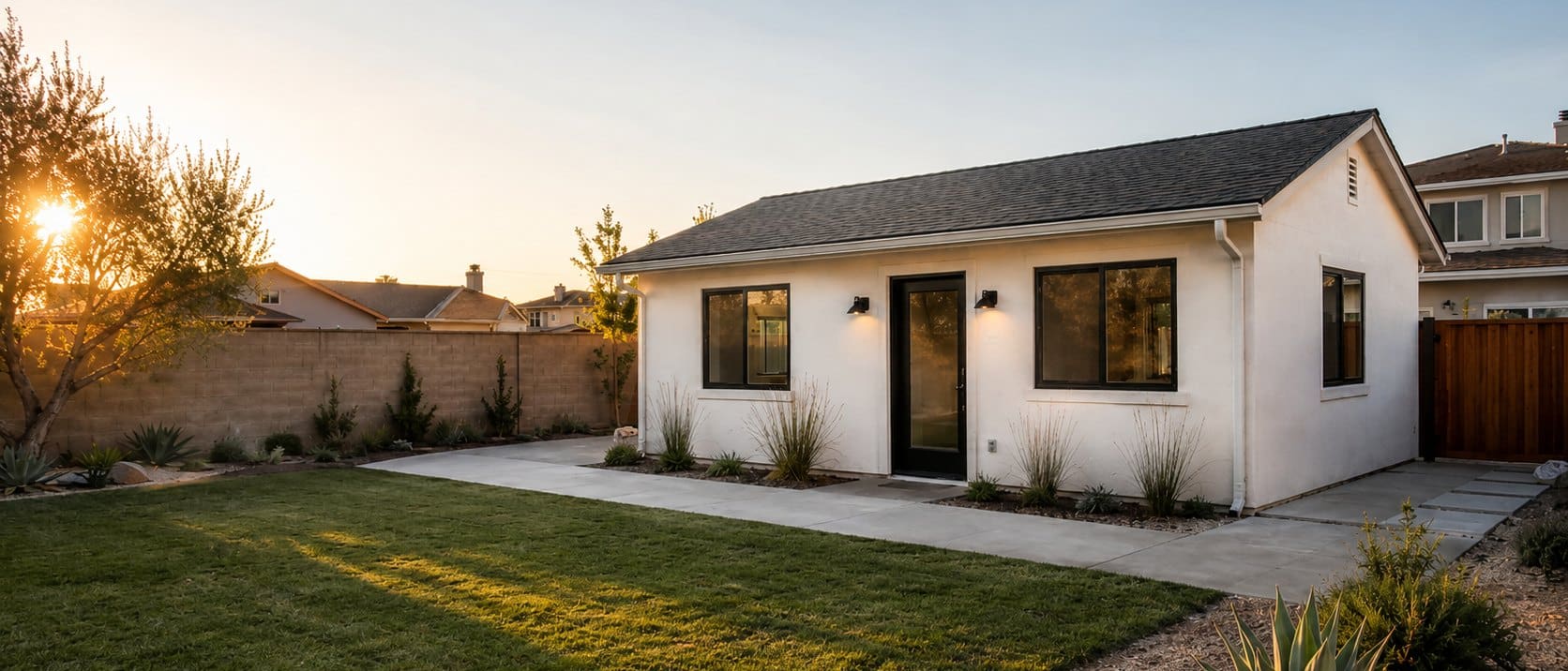
Honest cost ranges by ADU type (Orange County, 2026)
These reflect what we and other OC builders are quoting in 2026. They include design, permits, and construction, but not financing, furniture, or major off-site work (like a street-side sewer main upgrade).
| ADU type | Typical OC range (2026) | $/sq ft |
|---|---|---|
| Garage conversion (reusing existing walls/slab) | $90K–$150K | $150–$300 |
| Attached ADU (bolted onto the house) | $150K–$280K | $250–$400 |
| Detached custom (new standalone build) | $200K–$450K+ | $300–$450 |
| JADU (≤500 sq ft, inside the house) | $60K–$130K | varies |
These align with what credible 2026 sources are reporting for the region — garage conversions around $90K–$135K, detached units in the $200K–$400K+ band, and a California-wide average of roughly $300–$500/sq ft for new construction.
Cost by size: a real comparison
Per-square-foot pricing is misleading because the expensive parts — a kitchen, a bathroom, a panel, a sewer tie-in — cost about the same whether the unit is 500 or 1,000 sq ft. So the per-foot number drops as the unit grows, even though the total goes up.
Here’s the comparison I draw for most homeowners:
- A ~600 sq ft garage conversion. The slab and three walls already exist. We’re insulating, running new plumbing and electrical, adding a kitchen and bath, and bringing it to code. Often $110K–$160K. The catch: an old garage slab frequently isn’t thick enough or level enough for living space, and the roof may need structural work — so “we already have the box” doesn’t always mean cheap.
- A ~1,000 sq ft detached custom ADU. Everything is new: foundation, framing, roof, full utility runs. Often $320K–$450K+. You’re paying more in total, but you get a real second home — better light, layout, and resale value than a converted garage.
Same family, same lot, very different projects. The garage conversion wins on budget; the detached unit wins on livability and long-term value. Neither is “right” — it depends on what you’re solving for.
The 7 things that actually move your ADU price
This is where a firm number comes from. When I walk a lot, these are the conditions I’m checking, because each one can swing the budget by thousands.
- Electrical panel capacity
A new dwelling needs its own circuits. If your main panel is 100-amp and maxed out, you’re looking at a panel upgrade or a subpanel — often $3K–$8K, more if the utility has to get involved.
- Gas line
Running a new gas line to a detached unit (for a range, furnace, or tankless water heater) adds cost and sometimes a separate meter. Going all-electric can sidestep this entirely — a real design decision, not just a fixture choice.
- Sewer lateral distance
How far the ADU sits from the existing sewer connection drives trenching cost. A unit near the main line is cheap to tie in; one at the back of a deep lot can mean 60+ feet of trenching — or a sewage ejector pump if gravity won’t cooperate.
- New utility meters
Some cities and situations require separate water/electric meters; others let you sub-meter or share. This affects both upfront cost and your monthly bills.
- Demolition
Removing an old garage, shed, slab, or mature concrete adds line items before construction even starts — and occasionally uncovers surprises (buried debris, undersized footings) underneath.
- Lot slope
A flat pad is the cheapest case. A sloped lot means more grading, retaining, or a raised/stepped foundation — one of the bigger silent cost drivers in OC’s hillier neighborhoods.
- Site access
Can a concrete truck and an excavator reach the build area, or does everything get wheelbarrowed through a 36-inch side gate? Tight access is pure labor cost, and it’s invisible on a satellite photo.
None of these show up in an online calculator. All of them show up in a real quote. That’s the honest reason the range is wide — and the honest reason we give a firm written number only after we’ve seen your lot.
What the state lets you build (so you don’t over-spend on assumptions)
California’s ADU rules are set by CA HCD and apply statewide, on top of each OC city’s local code. The basics worth knowing before you budget:
- ADUs can be built up to roughly 1,200 sq ft (cities can’t cap a detached ADU below 800 sq ft).
- 4-foot side and rear setbacks are allowed for ADUs — you don’t need the larger setbacks a main house requires.
- A JADU must be 500 sq ft or less and sits within the existing home’s footprint, which is why it’s usually the cheapest path to a legal second unit.
Knowing these limits keeps you from paying to design something a city will reject — a common and expensive false start.
How to get a number you can trust
A real quote is a two-step process: a site visit to check those seven conditions, then a written scope with line items you can actually compare against other bidders. If a quote is one number on one page, you can’t tell what’s missing — and what’s missing becomes a change order.
If you want to dig deeper by type, here are our detailed guides:
When you’re ready for a real number on your actual lot, contact us or call (949) 374-7980. We’ll walk the property, check the seven conditions above, and give you a firm written quote — no guessing.